
Kobayashi Bar: Professional Build Guide
Commercial Bar Design Layouts & Ideas
The stainless steel underbar components, dimensions, and layout principles that professional bar builders specify on every project.
By Yu Jiang Zhao, Founder of Kobayashi Bar · Updated March 2026
Commercial bar design is the process of planning a bar’s floor plan, working zone dimensions, underbar equipment layout, material specification, and plumbing to support sustained, high-volume beverage service in a restaurant, hotel, or venue.
A bar is the revenue center of your operation. Every decision made during the design phase: the bar layout type, working zone width, cocktail station size, drink rail position, and, drain plan, directly determines how many covers your team can handle per hour and how long your build lasts before it needs replacing.
This guide covers commercial bar design from the ground up: seven layout types with real equipment specs, standard dimensions, material selection, working zone ergonomics, a complete equipment essentials list, and the stainless steel underbar components that professional bar builders specify on every project.
Kobayashi Bar manufactures 18-gauge 304 stainless steel bar stations, drink rails, cocktail stations, and glass rinsers in the USA. Every product referenced in this guide is a Kobayashi product.
What sets commercial bar design apart from residential
Commercial bars differ from home bars in five measurable ways: professional-grade materials, throughput requirements of 150–300 drinks per peak hour, mandatory code compliance, ergonomic working zone design, and equipment built for 10–20 years of daily operation.
Home bars handle a few dozen drinks on a Friday night. Commercial bars handle that before 9 PM. The two categories have almost nothing in common except the word “bar.”
Materials
Commercial bars use 304 stainless steel (18-gauge) for all underbar work surfaces, drain pans, ice chests, speed rails, and drink rails. Stainless is non-porous, so bacteria and mold have no surface to penetrate. It survives daily contact with citrus, simple syrup, carbonated mixers, and bleach sanitizer.
Volume throughput
A high-volume restaurant bar produces 150 to 300 drink builds per peak hour. A craft cocktail bar produces 60 to 120. Every dimension in the floor plan exists to support that output without the bartender taking more than one step per build.
Ergonomics
Bartender fatigue reduces service speed and accuracy during the second half of a long shift. Commercial bar design accounts for working surface height (36 inches), reach distance (18 to 24 inches), and aisle width (30 to 48 inches) to reduce physical strain across a 10-hour service day.
Equipment lifespan
Commercial-grade stainless steel bar equipment is rated for 15 to 20+ years of daily operation. Home bar furniture typically lasts 5 to 12 years under light use. In a commercial setting, that lifespan compresses to 2 to 5 years.
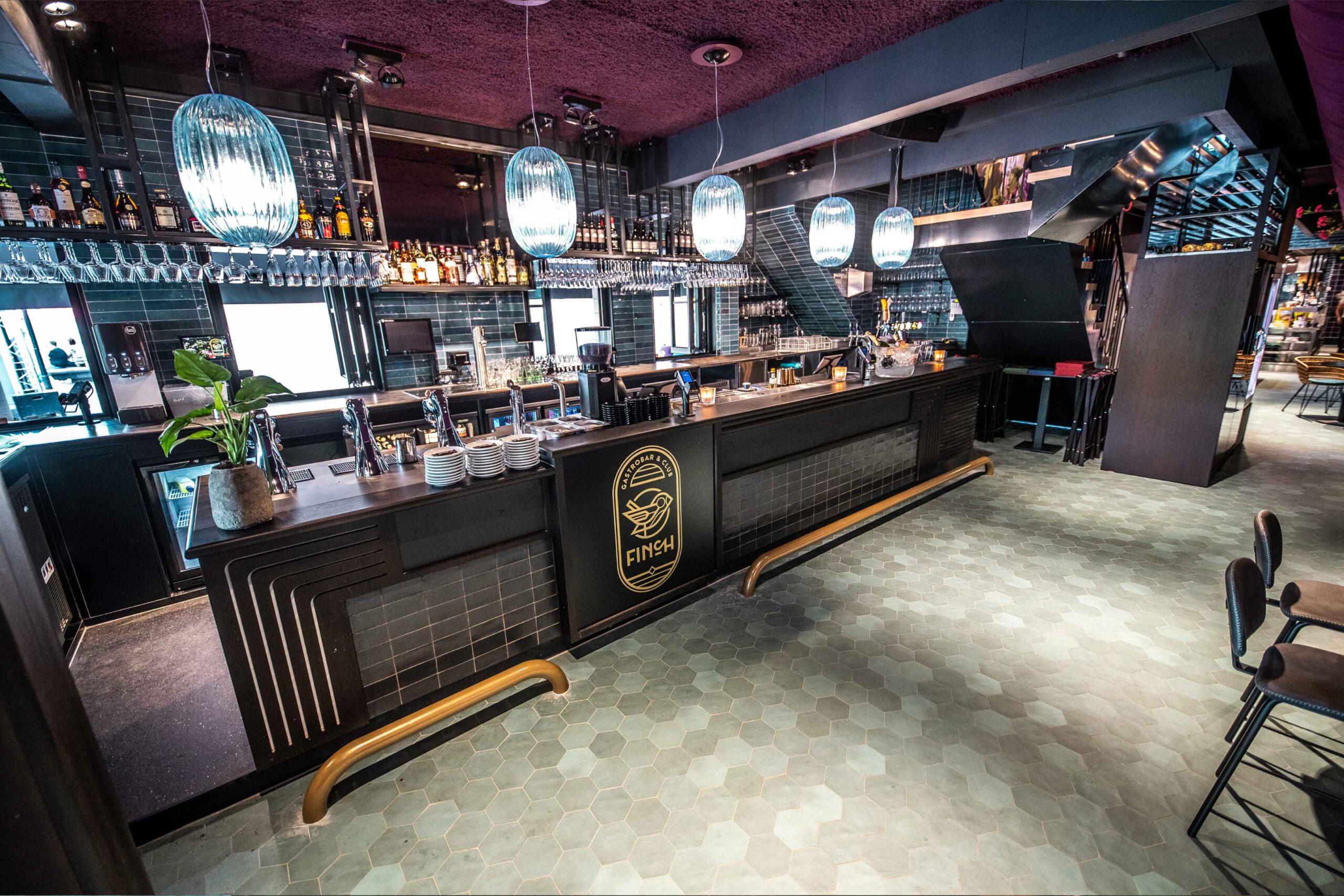
The 7 commercial bar layout types
The 7 commercial bar layout types are: linear (straight bar), L-shape, U-shape (horseshoe), island bar, peninsula bar, modular bar, and service bar. Each layout determines equipment placement, traffic flow, seating capacity, and working zone configuration.
The bar floor plan you choose locks in every downstream decision: how many bartenders fit, where the ice goes, which station size you need, and how guests and servers move through the space.
Floor plan blueprints
Top-Down Layout View
01
Linear bar
Single wall. Best for sports bars, neighborhood taverns, hotel lobby bars. Spec: 65″ drop-in for 12–18 ft; 88″ for 18–30 ft.
02
L-shape bar
Two arms, two zones. Best for restaurant bars, craft cocktail bars. Spec: 52″ on short arm, 65″–88″ on primary arm.
03
U-shape (horseshoe)
Three arms, center well. Maximum seating. Best for hotel bars, casino bars. Spec: 88″ drop-in, dual glass rinsers.
04
Island bar
Freestanding, four-side access. Maximum visual impact. Best for hotel lobbies, rooftop bars. Spec: Stainless underbar both service sides.
05
Peninsula bar
One arm into dining room. Natural traffic separation. Best for restaurant bars with dual-service requirements. Spec: 65″ station on main arm.
06
Modular bar
Freestanding units, rearrange as needed. Best for event venues, catering, hotel ballrooms. Spec: Standing stations in 52″ or 65″.
07
Service bar (back-of-house)
No guest seating. Maximum production density. Best for high-volume restaurants, banquet operations. Spec: 88″ + 65″ drop-in stations, dual glass rinsers, 12-bottle speed rail.
Standard bar dimensions for commercial design
Standard commercial bar dimensions: bar top height 42 inches (guest side), back bar working height 36 inches, bar top depth 16–18 inches (guest), 18–24 inches (working side), aisle width 30–36 inches (single bartender), 42–48 inches (two staff), underbar depth 24 inches.
Dimension errors in commercial bar design are permanent. A bar top built 3 inches too wide creates a dead zone guests cannot reach. An aisle 4 inches too narrow causes bartenders to turn sideways past each other during a rush.
| Dimension | Standard | Operational notes |
|---|---|---|
| Bar top height (guest-facing) | 42 inches | Matches counter-height barstool seating |
| Back bar working height | 36 inches | Ergonomic working surface for standing bartender |
| Bar top depth (guest side) | 16–18 inches | Allows guest to reach drink without leaning |
| Bar top depth (working side) | 18–24 inches | Speed rail, ice, and tools within arm reach |
| Aisle width (single bartender) | 30–36 inches | Minimum clearance for full movement |
| Aisle width (two bartenders) | 42–48 inches | Passing without stopping |
| Underbar depth | 24 inches | Standard depth for all underbar equipment |
| Back bar display height | 60–72 inches | Bottle display visible to guests |
| Foot rail height | 8–10 inches off floor | Standard bar foot rail position |
| Drink rail height | 3–4 inches above bar top | Separates guest zone from working surface |
| Bar top overhang (front) | 6–10 inches | Guest knee clearance on barstool |
Kobayashi station dimensions
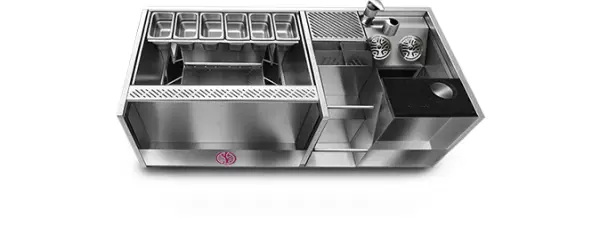
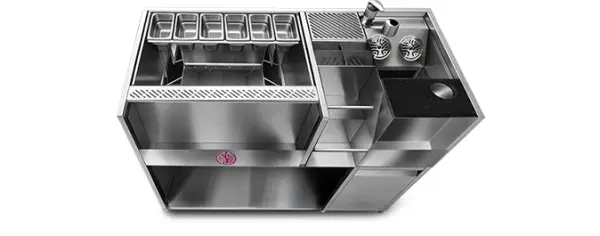
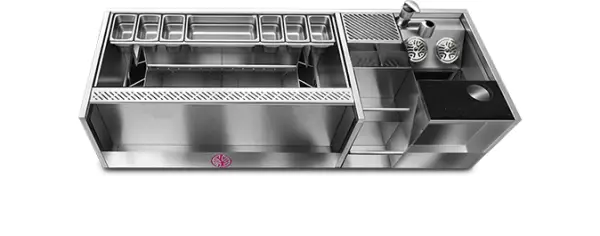
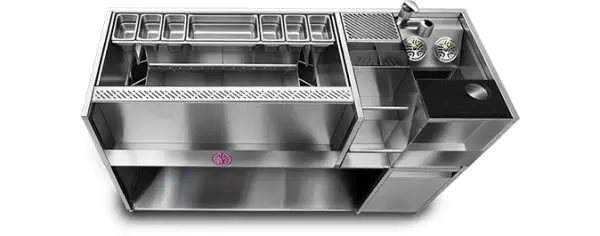
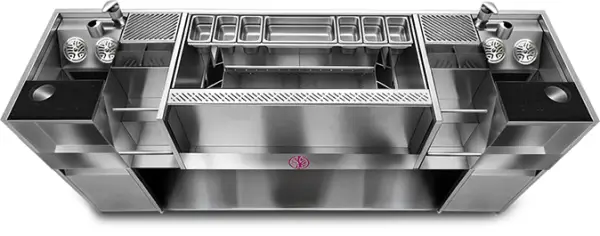
Kobayashi drop-in cocktail stations are engineered to the 24-inch underbar standard depth. Available in 52″, 65″, and 88″ working zone lengths, each size matched to the linear seating runs of the seven layout types above. Standing stations use the same footprint for modular and freestanding configurations. View spec sheets at kobayashibar.com.
Kobayashi Bar: Made in USA
Cocktail Stations
18-gauge 304 stainless steel. Drop-in and standing configurations. Built to commercial specifications.
Bar equipment essentials: the complete list
A fully equipped commercial bar requires equipment across six categories: production, refrigeration, beverage dispensing, glass management, drainage, and utility. The production equipment determines your service speed; everything else is downstream.
Most bar owners focus on the bar top and the bottle display. The equipment that actually runs the operation (the ice maker, the keg system, the soda gun) gets specced last and often compromised on budget. That’s the wrong sequence.
Ice Maker
The single most important piece of equipment in a commercial bar. A bar that runs out of ice at 9 PM cannot serve cocktails, cannot keep beer cold, and cannot keep the glass rinser functional. Sizing rule: 1.5 lbs of ice per drink per peak hour, plus 20% buffer. A 200-seat bar needs 350–400 lbs/day minimum.
Soda Gun & Cold Plate
Delivers carbonated mixers directly to the bartender’s hand. Reduces pour time per mixer from 4–6 seconds (bottle) to under 1 second (gun). Over a 200-drink service, that’s 10 to 15 minutes of recovered time per bartender. The cold plate chills soda lines via the ice chest before they reach the gun.
Back Bar Coolers & Bottle Fridges
Keep beer, wine, and pre-batched cocktails at serving temperature. Temperature zones: Beer and lager: 34–38°F. White wine and rosé: 45–50°F. Pre-batched cocktails: 36–40°F. Spirits do not require refrigeration.
Beer Kegs & Draft System
Direct draw: keg directly below the tap tower, works for runs under 10 feet, no glycol required. Remote glycol system: required for keg storage more than 10–25 feet from the taps. A 6-tap system handles most craft bar programs. Sports bars often run 16–32 taps.
Commercial Dishwasher
Runs a complete wash cycle in 90 to 120 seconds versus 25–45 minutes for a residential dishwasher. In a high-volume bar, glassware turnover is a direct throughput constraint. Under-counter bar glass washers fit the 24-inch underbar depth and run 40–50 racks per hour.
Water Filtration
Unfiltered water produces ice with off-flavors, scales up glass rinsers and dishwashers, and affects carbonated mixers. Most commercial ice machine manufacturers require a filtration system to maintain the warranty, as scale buildup is the most common cause of ice machine failure.
Speed Rail
The tilted rack that holds most-poured spirits within arm’s reach. A bartender reaches for the speed rail 50 to 100 times per service hour. Standard capacity: 9-bottle rail covers house pours. High-volume bars run 12-bottle rails. Included with every Kobayashi cocktail station.
POS System & Payment Terminals
A slow POS costs as much service time as a poorly placed glass rinser. Placement: POS terminals belong at the ends of the working zone, away from the primary mixing station. Wireless handheld terminals remove the bar POS as a bottleneck during peak service.
Kobayashi stations as the integration hub
Every piece of equipment above connects to the Kobayashi cocktail station as the central hub. The integrated ice bin supplies the glass rinser and drink builds. The speed rail sits within the station frame. The soda gun holster mounts to the station edge. The drain system routes through the station. Spec the station first, then size everything else to fit. Available in 52″, 65″, and 88″ at kobayashibar.com.
The commercial underbar: stations, rails, and rinsers
The commercial underbar is the integrated equipment assembly that forms the bartender’s working zone. It consists of the cocktail station, speed rail, ice chest, glass rinser, and drink rail, all positioned to keep a bartender’s feet planted during 90 percent of drink builds.
Kobayashi cocktail station
The cocktail station is the primary production center. It integrates the speed rail, ice bin, and mixing area into one unit, positioned so the bartender can access spirits, ice, and tools without relocating. A properly sized station handles 80 to 90 percent of drink builds from a single standing position.
- 52″ Drop-In: For bars under 15 feet. Service bars, small restaurant bars, wine bars.
- 65″ Drop-In: For 15–22 foot bars. The most common size for restaurant bars and craft cocktail programs.
- 88″ Standing: For high-volume operations over 22 feet. Dual glass rinsers; 12-bottle speed rail.
- All models: 18-gauge 304 stainless steel, integrated speed rail, ice bin with drain connection, matching drink rail sizing.
Kobayashi drink rail
The drink rail is the raised ledge running along the guest-facing edge of the bar top. It separates the guest’s drink from the bartender’s working surface, prevents glasses from sliding off under service pressure, and defines the boundary between the guest zone and the production zone.
- Kobayashi drink rail sizes: 52″, 65″, and 88″ , matched exactly to drop-in station lengths for a continuous flush surface edge.
- Material: 18-gauge 304 stainless steel. Wood drink rails absorb moisture and bacteria and fail within 3 to 5 years of commercial use.
Kobayashi glass rinser
A bar glass rinser forces a cold water jet up through a glass in approximately 1 second, rinsing residuals and pre-chilling the vessel before filling. In craft cocktail programs, the pre-chill adds 2 to 4 degrees of temperature retention to a served drink without additional dilution.
- Required threshold: Any bar producing 100 or more drinks per service hour.
- Placement: Adjacent to the ice chest and mixing area, the highest-traffic point of the working zone.
Material selection for commercial bar surfaces
The correct material for commercial bar work surfaces is 18-gauge 304 stainless steel. It resists corrosion from citric acid, acetic acid, carbonic acid, and chloride sanitizers, and provides a 20+ year operational lifespan under daily service conditions.
Material selection for a commercial bar is a compliance and operations decision. The wrong material on a working surface degrades under commercial cleaning chemicals and requires replacement within 3 to 7 years.
| Surface material | Commercial rating | Best application | Lifespan |
|---|---|---|---|
| 304 stainless steel (18ga) | Highest | All underbar surfaces, drink rails, ice chests, speed rails | 20+ years |
| Granite / natural stone | High (bar tops only) | Guest-facing bar top surface | 15–25 years |
| Quartz (engineered stone) | High (bar tops only) | Guest-facing bar top surface | 15–25 years |
| Sealed concrete | Medium | Designer bar tops | 10–20 years |
| Solid hardwood | Low for work surfaces | Back bar shelving, decorative | 5–15 years |
| Laminate | Not recommended | Avoid in commercial builds | 3–7 years |
| Chrome-plated steel | Low (wet environments) | Avoid for speed rails and drain surfaces | 3–7 years |
Why 304 stainless specifically
Grade 304 stainless steel contains 18% chromium and 8% nickel, giving it corrosion resistance to citric acid, acetic acid, carbonic acid from mixers, and chloride-based sanitizers, all of which exist in a bar environment simultaneously. Grade 430 corrodes faster. Grade 316 is over-specified. 304 is the correct specification for all commercial bar underbar equipment.
How to design the commercial bar working zone
The commercial bar working zone is the 18–24 inch deep area in front of the bartender, between the drink rail and the back of the underbar equipment. An efficient working zone positions ice, spirits, and mixing tools within a 2-foot radius, eliminating step-based time loss during drink production.
The bartender’s triangle: ice at one point, spirits at another, mixing tools at the third, with the glass at the center. Every inch added to the triangle is a lost second per drink build.
Working zone layout (left to right, right-handed setup)
- Glass storage: Closest to dominant hand, in the underbar cabinet or on a rail-mounted glass rack above the working surface.
- Ice chest and speed rail: Center position, the highest-traffic point of the working zone. Ice and spirits accessed together for the majority of drink builds.
- Cocktail station / mixing area: Primary production surface. Integrated with ice chest and speed rail into one unit.
- Glass rinser: Adjacent to ice and mixing zone. Pre-rinse and chill the glass before building the drink.
- Soda gun: Mounted to the cocktail station edge, within reach of the primary mixing position.
- POS terminal: End of bar, positioned away from the primary production zone.
Kobayashi stations solve working zone design
Kobayashi drop-in and standing cocktail stations are built around the bartender’s triangle principle. The integrated speed rail, ice bin, and stainless work surface consolidate the three primary production points into one 52″, 65″, or 88″ unit, eliminating the ad hoc placement decisions that fragment working zones in bars built without purpose-designed equipment.
Code compliance in commercial bar design
Commercial bar design must satisfy 5 regulatory categories: approved materials on food-contact surfaces, dedicated handwash sink within 20–25 feet, three-compartment sink for in-bar glass washing, floor drains under all ice storage, and AHJ sign-off on fire suppression and electrical systems.
Food-contact surface standards
Any surface that contacts food or beverage in a commercial establishment must be smooth, non-porous, and sanitizable with commercial cleaners without material degradation. 18-gauge 304 stainless steel meets this standard across all jurisdictions. Unsealed wood, chrome-plated steel, and laminate do not.
Dedicated handwash sink
A handwash sink, separate from the glass-washing or three-compartment sink, must be accessible from the bar working zone within 20 to 25 feet. The sink must have hot and cold running water, liquid soap dispenser, and single-use paper towels. This is the most frequently cited violation in commercial bar health inspections.
Three-compartment sink
Commercial bar operations that wash glassware on-premises require a three-compartment sink: one for washing, one for rinsing, one for sanitizing. Many operations move glass washing to back-of-house to free up bar floor space, compliant as long as the three-compartment sink is accessible to bar staff.
Plumbing and floor drains
Floor drains are required under all ice storage equipment and glass-washing sinks. Plan plumbing during the design phase. Retrofitting drain work after bar construction is the most expensive mistake in the commercial bar build process.
Fire suppression and building code
Fire suppression requirements depend on whether the bar includes cooking equipment. Confirm all requirements with the local Authority Having Jurisdiction (AHJ) before finalizing the bar floor plan. Moving walls or equipment after permit review adds weeks and significant cost.
12 proven commercial bar configurations
These configurations reflect what professional bar builders and operators spec across the most common commercial bar contexts. Each includes a Kobayashi equipment call-out because the equipment spec is the most common point of error in a commercial bar build.
01: Linear craft cocktail bar (12–18 ft)
Kobayashi 65″ drop-in station. Full-length drink rail. Single glass rinser adjacent to ice. Soda gun mounted to station right side. Under-counter cooler for fresh juice. Aisle width 36″.
02: High-volume sports bar (18–30 ft)
Kobayashi 88″ drop-in. 12-bottle speed rail. Dual glass rinsers. Draft system with 8–16 taps. Glycol cooling for keg runs over 15 feet. Two POS terminals. Commercial ice maker 500+ lbs/day.
03: Hotel lobby bar (island layout)
Kobayashi standing stations on two service faces. Portable drink rails on all four sides. Pass-through coolers. Utility lines through the floor. Aisle width 48″ for guest traffic flow.
04: Rooftop or outdoor bar
Kobayashi stainless standing stations, open-frame. Ice chest with extended insulation rated above 80°F. Floor drain routing for rain exposure. Equipment secured against wind.
05: Restaurant service bar
Kobayashi 52″ drop-in, compact working zone. Maximum ice chest capacity. Speed rail to 12 bottles. Adjacent to kitchen pass. Under-counter commercial dishwasher for rapid glass turnover.
06: Craft beer bar with tap wall
Kobayashi cocktail station on one end. Direct-draw keg system for taps under 10 feet; glycol for longer runs. Drain tray full tap wall length. CO2 and nitrogen lines for mixed programs.
07: Small bar (under 20 seats)
Kobayashi 52″ standing station. Single glass rinser. Wall-mounted bottle shelving. Kobayashi drink rail on the short guest-facing run. Two-door under-counter cooler. Aisle width 30″ minimum.
08: Event venue flex bar
Kobayashi modular 52″ units, deployable in any linear or L-shape configuration. Portable drink rails. Quick-connect water lines. Portable ice maker. No permanent bar structure.
09: Wine bar
Reduced ice footprint. Floor-to-ceiling wine rack integration. Lower working surface for bottle-pour ergonomics (34″ vs 36″). Temperature-controlled display cooler at 45–50°F. Kobayashi glass rinser retained.
10: High-end cocktail lounge
Kobayashi 52″ drop-in in brushed stainless. Under-counter refrigeration for fresh juice. Back bar bottle display at 72″ with pin lighting. Granite or marble bar top with Kobayashi drink rail.
11: High-volume hotel bar
Kobayashi 88″ drop-in. Commercial glass washer in dedicated back-of-house room. Dual handwash sinks. Two POS terminals. Glycol draft system. Aisle width 48″. Ice maker 600+ lbs/day.
12: Outdoor patio or pool bar
Kobayashi stainless standing stations, open-frame construction. All hardware 304 stainless or marine-grade aluminum. Drainage sloped to exterior floor drain. Lockable equipment covers for off-hours.
Kobayashi Bar: Drink Rails
Stainless Steel Drink Rails
18-gauge 304 stainless. Sized to match every cocktail station. Integrated drain system. Optional custom logo engraving.
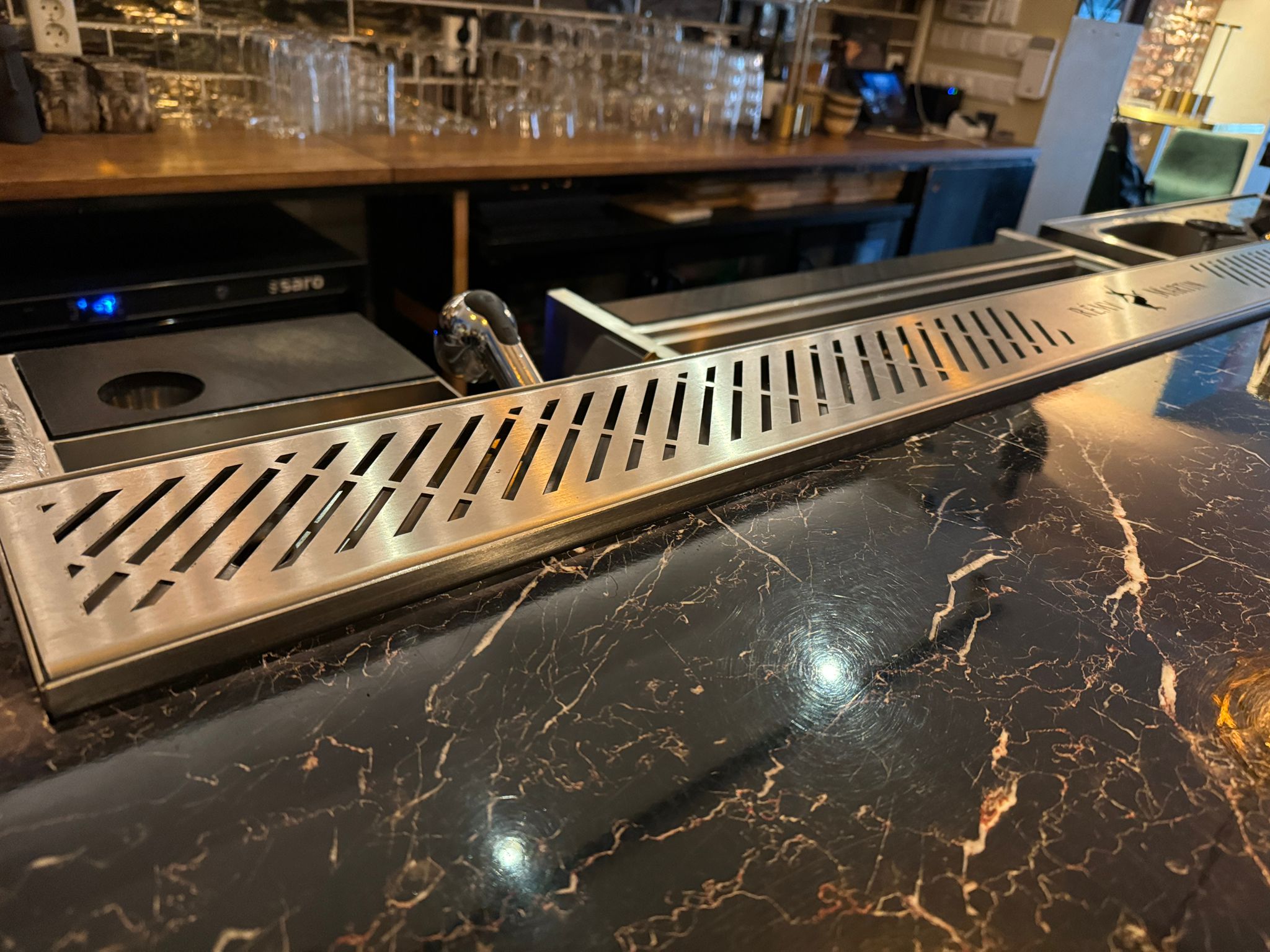
New Product
Commercial Stainless Steel Drink Rails
Keep your bar top clean and organized with Kobayashi drink rails. Built from the same 304 stainless steel as our cocktail stations, with an integrated drain system and optional custom logo engraving.
- 304 Stainless Steel
- 100% Passivated
- Integrated Drain
- Custom Logo Engraving
- 3 Sizes Available
- Lifetime Guarantee
The commercial bar design process, step by step
Commercial bar design follows 8 sequential steps: define service model, establish floor plan and utilities, spec working zone dimensions, select underbar equipment, specify drink rails, select production equipment, plan plumbing and drain, then execute construction, plumbing first, equipment last.
Commercial bar design failures are almost always sequencing failures. A dimension decided before the equipment was specified, a drain planned before the floor slope was set, or equipment ordered before the permit was reviewed.
Define the service model
What does this bar produce? High-volume cocktails, draft beer, wine-forward, event flex, service-only? The service model determines layout type and every downstream equipment decision.
Establish the floor plan
Measure the space. Identify existing utility locations: water supply, floor drains, electrical panels. Choose layout type based on space shape, seating target, and service model.
Spec working zone dimensions
Set bar top height (42″), back bar working height (36″), working zone depth (18–24″), aisle width (30–48″ depending on staffing), and underbar depth (24″).
Select underbar equipment
Choose Kobayashi cocktail station size (52″, 65″, or 88″) based on working zone length. Specify ice chest capacity, glass rinser count, and speed rail length based on projected service volume.
Specify drink rails
Match Kobayashi drink rail length to cocktail station length. Specify drink rails for all guest-facing sections. Confirm drip tray placement at the service line.
Select production equipment
Size the ice maker to production volume. Specify soda gun and cold plate. Select back bar coolers, keg system, and commercial dishwasher based on service program.
Plan plumbing and drain
Route water supply to cocktail station, glass rinser, ice maker, and handwash sink. Place floor drains under every ice chest. Connect bar top drain through bar scupper to floor drain.
Execute construction in sequence
Rough plumbing and electrical first. Structural framing. Underbar equipment drop-in after cabinet is built. Bar top installation. Finish work and POS. Final equipment connection and inspection.
Why 304 stainless steel is the commercial bar standard
Every major commercial bar equipment manufacturer uses 304 stainless steel for work surfaces. Every professional bar specification calls for stainless on the working zone. This convergence reflects 50+ years of operational testing across millions of commercial bar installations.
Non-porous surface
304 stainless has no surface pores where bacteria, mold, and yeast can colonize. A wood surface looks like a sponge under magnification. A stainless surface looks like glass.
Corrosion resistance
18% chromium forms a passive oxide layer that regenerates when damaged. Survives daily contact with lime juice (pH 2), simple syrup, carbonated mixers, and commercial chlorine sanitizers.
Impact resistance
18-gauge (0.047″) handles repeated impact from heavy glassware, dropped bar tools, and ice scoops without denting or cracking under normal commercial use.
Sanitization compatibility
Commercial sanitizers degrade chrome plating, bleach wood, dissolve laminate adhesives, and pit aluminum. They have no effect on 304 stainless.

65″ Drop-In Cocktail Station · 18-gauge 304 stainless steel
Frequently asked questions
The standard height for a commercial bar top is 42 inches on the guest-facing side, matching standard counter-height barstool seating. The back bar working surface height is 36 inches for ergonomic standing operation. Foot rail height is 8 to 10 inches above the floor.
A commercial bar requires a cocktail station, speed rail, ice chest, glass rinser, drink rail, bar drain system, handwash sink, three-compartment sink, commercial ice maker, soda gun and cold plate, back bar coolers, draft beer system (if serving draft), and commercial dishwasher.
Choose the 52-inch station for bars under 15 feet, the 65-inch station for 15 to 22-foot bars, and the 88-inch station for high-volume operations over 22 feet. Drop-in stations integrate into the underbar cabinet; standing stations work for modular and event bar setups. The 65″ serves 120–170 guests with 1–3 bartenders.
A commercial bar needs approximately 1 to 1.5 pounds of ice per drink per peak service hour, plus 20 percent buffer. A 200-seat bar serving 150 drinks per hour needs an ice maker rated at 350 to 400 pounds per day minimum, plus sufficient underbar ice chest capacity to cover a full 3-to-5-hour service period without restocking.
A drink rail is a raised ledge on the guest-facing edge of the bar top, typically 3 to 4 inches above the bar surface, that separates guest glasses from the bartender’s working zone and defines the boundary between guest and production areas. Kobayashi drink rails are available in 52″, 65″, and 88″ to match cocktail station lengths, starting from $650.
A drop-in bar station integrates into an underbar cabinet built into the bar structure. A standing bar station is a freestanding unit that requires no cabinet installation. Kobayashi drop-in stations are used in permanent commercial bar installations; standing stations are used in modular, event, or temporary bar setups.
A commercial bar build from permit submission to opening takes 8 to 16 weeks. The construction itself runs 3 to 6 weeks: rough plumbing and electrical (week 1), framing and cabinet work (weeks 2–3), equipment installation and bar top (weeks 4–5), finish work (week 6). Kobayashi Bar ships equipment in 4–8 weeks from order.
A commercial bar costs $15,000 to $85,000+ to build depending on size, materials, location, and labor market. The equipment component (underbar stations, drink rails, glass rinsers, ice chests, ice maker, coolers, and draft system) typically runs $8,000 to $35,000. Kobayashi cocktail stations range from $5,590 (52″ drop-in) to $8,880 (88″ standalone).
About the Author
Yu Jiang Zhao
Co-founder, Kobayashi Bar · Bar Owner & Mixologist
12 years behind the bar. Designing the equipment that makes it work better.
Yu Jiang Zhao is the founder of Kobayashi Bar, a company that designs bar stations to bring clarity, rhythm, and flow to hospitality. Born into a Wenzhounese family that built its life in the Netherlands through resilience and craft, Yu began behind the bar of his family’s restaurant, where inefficient systems sparked his vision for better design. In 2017 he founded Kobayashi, transforming years of hands-on experience into a company now serving bartenders across Europe and the United States.
View full bio →Specify your commercial bar with Kobayashi
We work with bar owners, restaurant designers, general contractors, and project architects to supply professional-grade stainless steel underbar equipment for commercial bar builds of any scale.
Every station includes a 1-hour bar design consulting session.