Where the bar goes in a basement
Put the bar along the longest uninterrupted wall, away from the stairs and the mechanical room, with a 36 to 42-inch aisle behind it for whoever is pouring. Build the seating side toward the open lounge so guests face the room, not the wall.
The two basement realities that drive the layout are headroom and obstructions. Ductwork, a soffit, or a steel support post can sit right where you wanted the back bar, so map them first. A freestanding station is a real advantage here: at standard bar height it clears low ceilings and soffits, and because it is not built in, you can slide it to dodge a post instead of reframing the room.
Keep the work zone and the social zone separate. The person making drinks needs the aisle behind the bar; everyone else stays on the lounge side. That single decision, drawn to scale before you build, is what separates a basement bar that flows from one that jams up every time three people stand near it.
Most codes want 7 ft (84 in) finished. A station sits at 42 in, so it clears low ceilings.
Map posts, soffits, and ductwork first. A freestanding bar slides to dodge them.
Leave 36 to 42 in behind the bar so the pour zone never jams.
Anything built in must still fit down the stairwell. Modular stations break down to pass.
Basement bar layouts
Three layouts cover almost every basement. Pick by the shape of your clear wall space and where the stairs land:
Not sure which fits? The fastest way to know is to draw it to scale. Our free Bar Designer tool lets you set your basement dimensions, switch to an L-shape for a corner, and drop in a real station at its true footprint, so you see the clearances before you commit a dollar.
Plan your basement bar to scale
Set your room, drop in a to-scale station and drink rail, snap them into place, and export a floor plan plus a quote. No signup.
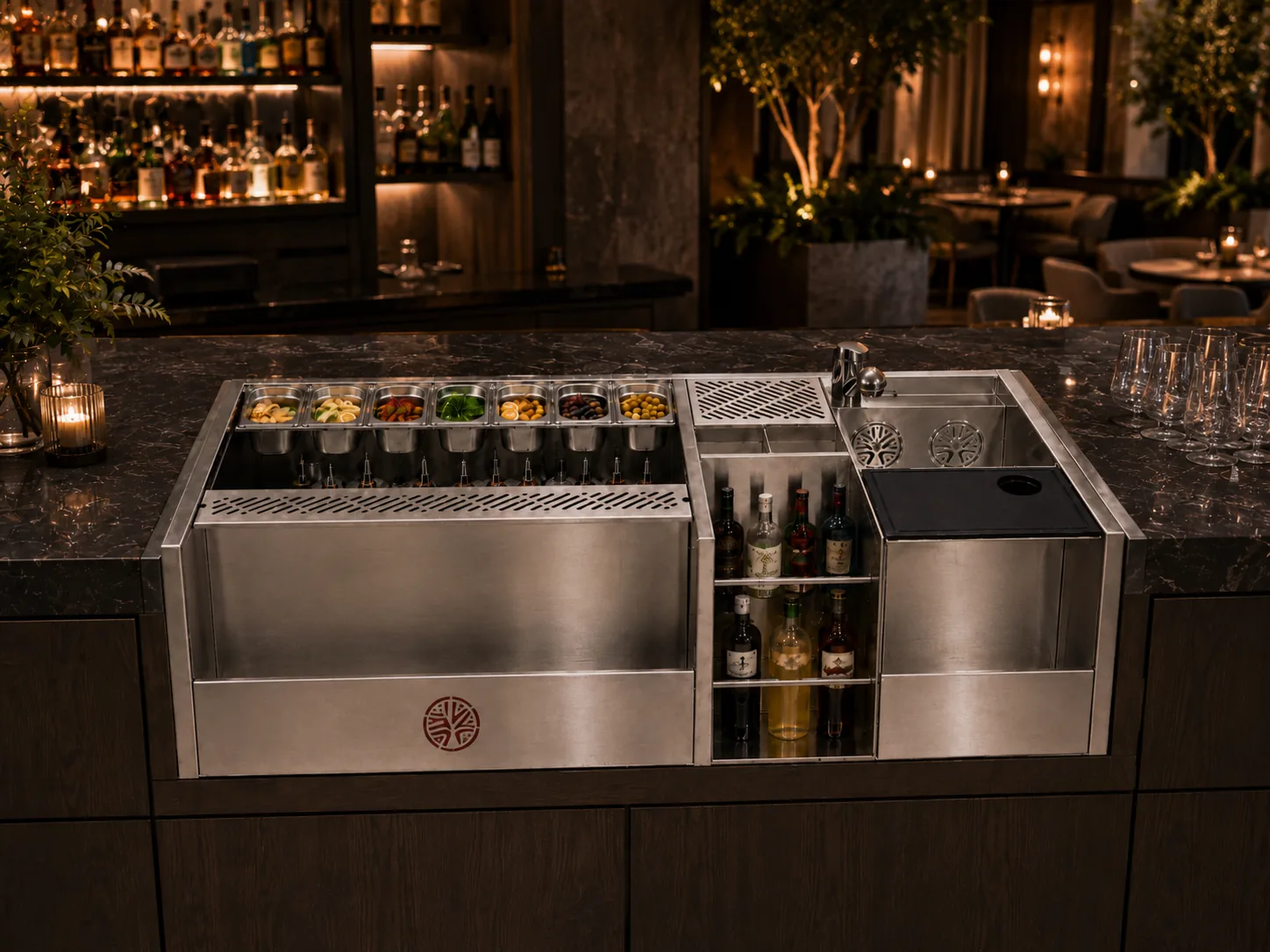
A basement rewards a compact, tough station, standalone if it has to come down the stairs in pieces, drop-in for a finished island or back bar:
Wet bar, plumbing & moisture
A basement is the easiest place in the house to add a wet bar, because the main drain and water lines usually run right through it. If a rough-in or floor drain is nearby, a built-in sink is affordable. If not, a freestanding station runs a rinser off its ice well with no plumber at all.
Two things make basements different from any other bar room. First, plumbing is often close: the foundation drain, a laundry rough-in, or the main stack may sit within a few feet, which keeps a wet-bar sink and drain cheap to connect. Second, moisture matters: basements run humid, so choose finishes that shrug it off. A 304 stainless station does exactly that, it will not warp, swell, or grow mildew the way a wood or laminate bar can, and it wipes down in seconds.
For any permanent water supply or drain, use a licensed plumber and connect to code. Where a drain is genuinely impractical, the Kobayashi station's integrated ice well plus an optional water tank and electric pump give you a working glass rinser on a standard 110V outlet, no trenching the slab.
What a basement bar costs
Budget falls into three honest tiers. The station is the one piece that does real bartending work, so it anchors every tier:
Starter, $2,500 to $6,000
A freestanding 52-inch station against a finished wall, stools, and back-bar shelving. A real bar with ice and rinse, no construction.
Built-in wet bar, $8,000 to $15,000
A drop-in station in a built counter, cabinetry, a plumbed sink, and lighting. The most popular finished-basement build.
Full lounge, $15,000 to $25,000-plus
An island or full back-bar wall, draft system, glass storage, and seating for a crowd. The taphouse-in-your-basement build.
The commercial stainless station at the center runs $5,590 to $7,500 depending on size and options. A licensed plumber for a wet-bar sink and drain typically adds $1,500 to $4,000 depending on how close your drain already is.
Related guides & products
Bar Designer Tool (free)
Lay out your basement bar to exact scale and export a floor plan.
Man Cave Bar Design
Garage and basement man-cave layouts, kegerators, and tap systems.
Home Bar Design
The full home bar layout and dimensions guide.
Game Room Bar Design
Designing the bar around pool tables and screens.
Frequently asked questions
A basement bar ranges from about $2,500 for a freestanding station and a simple back counter to $20,000-plus for a finished wet bar with cabinetry, a drop-in station, plumbing, and a draft system. The commercial stainless station at the center runs $5,590 to $7,500, and a licensed plumber for a wet-bar sink and drain typically adds $1,500 to $4,000.
For a small basement, a 52-inch station is the sweet spot. It seats two to three guests at the counter, holds a 135 L ice well and speed rail, and fits against a single wall with room to work behind it. It also breaks down to pass through a standard 36-inch doorway and down a basement stair, which larger built-ins cannot.
Only if you want a built-in wet bar with a permanent sink. Many basements already have a nearby drain or rough-in from the foundation, which keeps a wet bar affordable. Where adding a drain is costly, a freestanding Kobayashi station runs a glass rinser off its integrated ice well plus an optional water tank and electric pump on a standard 110V outlet, no plumber required. Any permanent water or drain connection should be made by a licensed plumber to code.
Most building codes require a finished basement ceiling of at least 7 feet (84 inches). A Kobayashi station tops out at standard bar height (about 42 inches), so it fits comfortably under low basement ceilings and soffits. Plan your back-bar shelving and any pendant lights around ductwork and the 7-foot minimum before you build.
Start by mapping your basement to scale, including the stairs, support posts, and any soffits or ductwork, then place the bar along the longest clear wall with a 36 to 42-inch working aisle behind it. Our free Bar Designer tool lets you drop a real, to-scale station into your room and check clearances before you build.