The bartender's working triangle
Cocktail bar design is built around the bartender's working triangle: ice well, speed rail, and mixing/build surface within one arm's sweep. A station that keeps all three inside a 24-inch reach lets a bartender build 90 percent of cocktails without leaving the build position.
Everything good about a cocktail bar starts at the build position. A craft cocktail is a sequence of 6 to 12 precise motions, jigger, build glass, stir or shake, strain, garnish, and every inch added between the ice, the bottles, and the build surface multiplies across a full Friday. The job of the layout is to collapse that triangle so the bartender stays planted.
That is why a cocktail bar shares more DNA with a commercial kitchen line than with a back-bar display. The bottles on the wall are theater; the work happens in the well.
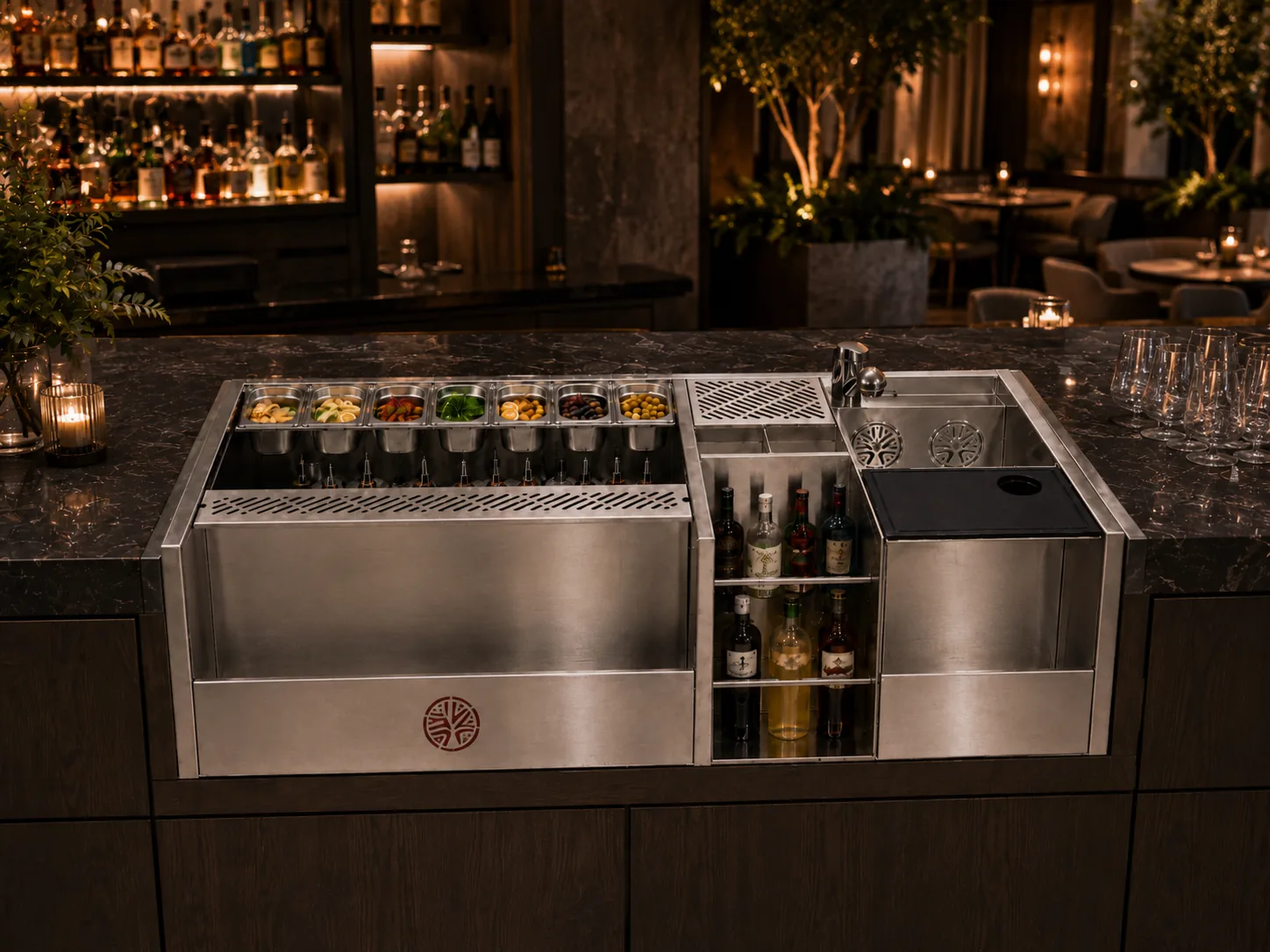
The center of gravity. 135 to 168 L of crushed and cubed ice within a single reach of the build surface so no cocktail waits on a runner.
The 7-to-12-bottle rail of house pours and modifiers at the build position, ordered by pour frequency so the bartender's hand finds them blind.
The 304 stainless working top where the cocktail is assembled, jiggered, stirred, and strained. Wipes clean between every drink.
Citrus, picks, bitters, and bar tools staged at the build position so the final 10 percent of the cocktail doesn't break the rhythm.
Cocktail bar layout types
The five working cocktail bar layouts are the linear single-wall bar, the L-shape, the U-shape (horseshoe), the island bar, and the service well. Each sets bartender count and throughput; all are built on the same 304 stainless station.
Pick the footprint to match the room and the volume, then drop in the station that fits. A neighborhood craft bar runs a linear 52 or 65-inch well; a high-volume cocktail lounge runs a U-shape with multiple wells so two or three bartenders never cross paths.
One run along the back bar. Simplest to build, easiest to staff. A 52 or 65-inch station fits most rooms.
Wraps a corner for more rail and a natural service end. Adds capacity without lengthening the room.
Three runs, multiple wells, maximum seating and throughput. For high-volume cocktail lounges.
A freestanding island for theater, or a no-seat service well that keeps dining-room tickets off the guest bar.
Craft cocktail bars run on a station with the ice well, speed rail, and rinser already aligned to the build position. The 65-inch is the craft-bar sweet spot; size down for compact rooms, up for high volume:
Build-station dimensions
A cocktail build station runs a 36-inch working surface behind a 42-inch guest bar top, with an 18-to-24-inch deep working zone and a 36-to-48-inch bartender aisle. Every Kobayashi station is 24 inches deep in 52, 65, and 88-inch lengths.
Dimensions are where most cocktail bars quietly lose speed. A working zone too shallow forces the bartender to crowd the build; an aisle too narrow makes two bartenders turn sideways during a rush. Set the guest bar top at 42 inches for counter stools and keep the 36-inch working surface clear for the build. Each station also carries a prep faucet that rises about 7.09 inches above the top, if an overhanging bar top or back-bar shelf sits above the station, leave clearance for it.
Speed rail and garnish organization
Speed rail by frequency
Order the rail by pour frequency, vodka, gin, rum, tequila, whiskey, then modifiers, so the bartender's hand finds each bottle without looking. 7 to 12 bottles per rail.
Dual ice, one well
Keep cubed ice for stirring and built drinks and crushed or pebble ice for juleps and tikis reachable in the same well. Integrated chests hold a full service without a runner.
Garnish at the build
Stage citrus twists, wheels, picks, and bitters in a stainless garnish tray at the build position so the final touch never costs a step.
Glass rinser
A one-second cold rinse resets coupes, rocks, and mixing glasses between builds and keeps glassware turning at peak.
Related guides & products
Commercial Bar Design Guide
The full 7-layout commercial bar playbook.
52" Mixology Station (shop)
The drop-in cocktail build station, in detail.
Commercial Bar Equipment
Stations, rails, ice bins, and rinsers.
Frequently asked questions
The working triangle is the arrangement of the ice well, speed rail, and build surface within one arm's reach of the bartender's build position. A cocktail bar designed around a tight triangle lets a bartender build roughly 90 percent of drinks without stepping or turning, which is the single biggest driver of speed during a rush.
A 65-inch station is the craft-cocktail sweet spot: 168 L of ice, a 12-bottle speed rail, and a glass rinser sized for a busy build. Compact neighborhood bars run a 52-inch (135 L ice); high-volume cocktail lounges step up to the 88-inch or run multiple wells in a U-shape.
A cocktail bar top is 42 inches on the guest side for counter-height stools, with a 36-inch working surface behind it for the bartender's build. Working-zone depth is 18 to 24 inches and the bartender aisle is 36 to 48 inches depending on how many bartenders work the well.
Order a speed rail by pour frequency: house vodka, gin, rum, tequila, and whiskey first, then high-use modifiers like triple sec and vermouth, kept in the same order across every station so any bartender can work any well blind. A standard rail holds 7 to 12 bottles; Kobayashi integrates it into the station at the build position.
A commercial cocktail bar runs $15,000 to $80,000-plus depending on size, finishes, and location. The underbar equipment package is typically $8,000 to $35,000; a Kobayashi 304 stainless station runs $5,590 to $9,250 and includes the integrated ice well, speed rail, and glass rinser that the build depends on.