Juice bar layout and workflow
Juice bar design follows the produce path: receive and wash, prep and cut, press or blend, fill and garnish, then hand off. Laying the counter out in that order, with a stainless work surface at the press and a rinse point at the build, keeps a single operator moving without backtracking.
A juice bar feels simple until a 9am rush hits and one operator is washing kale, cutting citrus, running a cold press, and filling cups at the same counter. The fix is the same one a kitchen line uses: lay the workflow out in one direction so product moves from wash to cup without ever crossing back over itself.
The center of that line is a durable stainless work-and-rinse surface. Produce is wet, acidic, and constant, and the counter takes a beating from citrus, ginger, beet, and turmeric all day.
A dedicated stainless wash and cut zone at the start of the line. Cold, wet, and acidic all day, needs an NSF surface.
The cold press or high-power blenders, centered so the operator pivots between prep and fill without stepping.
Cups, lids, and garnish staged at the build with a rinse point to reset jars, pitchers, and blender cups in seconds.
Under-counter refrigeration for prepped produce, pre-batched juice, and dairy or plant-milk for smoothies, within a half-turn of the build.
Why juice bars run on 304 stainless
The correct surface material for a juice or smoothie bar is 304 stainless steel. It is non-porous and NSF-grade, so the citric acid in citrus, the staining pigments in beet and turmeric, and constant water exposure cannot penetrate or corrode it the way they degrade laminate, wood, or coated steel.
A juice bar is one of the most punishing counter environments in food service: acidic, wet, and stained from open to close. 304 stainless is the same grade used in commercial kitchens and food-processing plants precisely because it shrugs off acid, pigment, and water and wipes down to clean between every batch.
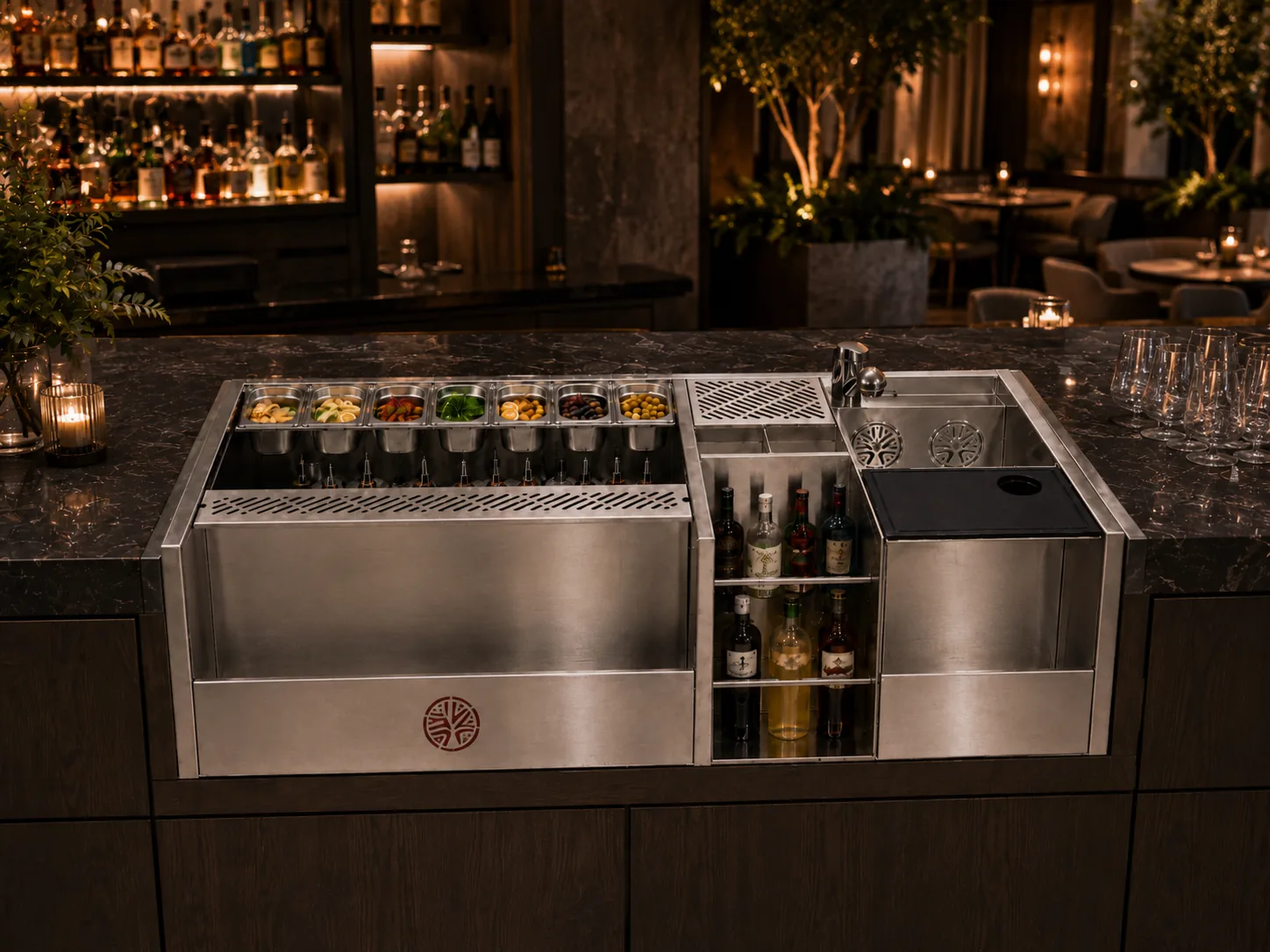
A juice or smoothie bar rewards a compact station with an integrated ice well and rinser at the build. The 52-inch is the juice-bar pick, drop-in to set into a counter run, standalone or portable to keep it freestanding:
Juice bar dimensions and the cup line
Size a juice bar around a 36-inch work surface and a 42-inch guest counter, with the press, blenders, and fill line inside one pivot. Kobayashi stations are 24 inches deep in 52, 65, and 88-inch lengths, the 52-inch suits a single-operator bar, the 65-inch a two-station line.
Plan the guest-facing counter at 42 inches for stool seating and keep the 36-inch working surface clear for the press and the cup line. Allow a 36-inch aisle behind the counter so an operator can move between wash, press, and fill without bumping. Each station carries a prep faucet rising about 7.09 inches above the top, leave clearance if a menu board, shelf, or overhanging counter sits above it.
Juice and smoothie bar equipment essentials
Cold press or centrifugal juicer
The production centerpiece. Cold press for premium shelf-stable juice; centrifugal for speed and lower cost.
High-power blenders
Two or more for smoothie volume so one keeps running while another is rinsed.
Integrated ice well
135 L holds a full day of ice for smoothies, iced drinks, and chilling pressed juice without a freezer run.
Rinse point at the build
Resets jars, pitchers, and blender cups in seconds, the detail that keeps a single operator moving through a rush.
NSF 304 stainless surfaces
Non-porous, acid- and stain-proof, wipe-clean between batches. The inspection-passing standard.
Related guides & products
Juice Bar Station (shop)
The 304 stainless station built for a juice or smoothie line.
Commercial Bar Design Guide
The full layout and dimensions playbook.
Commercial Bar Equipment
Stations, ice bins, and rinsers.
Frequently asked questions
Lay a juice bar out along the produce path: wash and prep at one end, the press or blenders in the center, and the fill-and-garnish cup line at the build, so product moves in one direction without backtracking. Anchor the line with an NSF 304 stainless work surface and a rinse point at the build to reset jars and blender cups between batches.
304 stainless steel is the best surface for a juice or smoothie bar. It is non-porous and NSF-grade, so the citric acid in citrus, the pigments in beet and turmeric, and constant water exposure cannot penetrate or corrode it the way they degrade laminate, wood, and coated steel.
A juice bar needs a cold press or centrifugal juicer, two or more high-power blenders for smoothies, under-counter cold storage for produce and plant-milk, an integrated ice well, a rinse point at the build, and NSF 304 stainless work surfaces. Kobayashi integrates the ice well and rinser into one stainless station at the center of the line.
A 52-inch station suits a single-operator juice bar: it holds a 135 L ice well and a rinser, fits a compact counter, and rolls through a standard doorway. A busier two-station line or a juice-plus-food concept steps up to a 65-inch.
A juice or smoothie bar runs $20,000 to $120,000-plus depending on size, equipment grade, and location, with a commercial cold press alone running $3,000 to $12,000. The 304 stainless underbar station that anchors the line runs $5,590 to $9,250 and includes the integrated ice well and rinser.