A coffee bar lives or dies on the first three feet behind the espresso machine. Get the milk pitcher rinser, syrup rail, ice well, and knock box placement right and a single barista can run 40 drinks an hour without breaking rhythm. Get it wrong and a 60-second drink takes 90 because someone keeps reaching across the build zone.
This guide covers coffee bar design from the ground up: seven layout types with real equipment specs, standard counter and aisle dimensions, the eight pieces of equipment every coffee bar needs, barista workflow ergonomics, 12 proven configurations, and how Kobayashi's 304 stainless bar stations work for cafes, restaurants, hotels, and home coffee setups.
Kobayashi Bar manufactures 304 stainless steel bar stations, drink rails, milk pitcher rinsers, and integrated speed rails in the USA. The same hardware that runs a craft cocktail program runs a craft coffee program. Need help designing a coffee bar? Our design team consults free for one hour on every quote.
What is a coffee bar?
A coffee bar is a dedicated production counter built around an espresso machine, grinder, milk fridge, ice well, and a 304 stainless work surface, designed to produce 30 to 300 specialty drinks a day. Coffee bars run as standalone cafes, embedded restaurant programs, hotel lobby setups, retail grab-and-go counters, or home kitchen build-outs.
Coffee bars share more with commercial cocktail stations than they do with a kitchen counter. Both run on a 36-inch working surface. Both need a milk or glass rinser within arm's reach of the build position. Both need ice on demand. Both live or die on the bartender or barista's ability to stay planted while assembling a drink.
Commercial coffee bars use 304 stainless steel for working surfaces, milk rinser, syrup rail, and ice well. Stainless is non-porous, so milk residue, coffee oil, and citric acid from espresso shots cannot penetrate. It survives daily wiping with espresso machine cleaner and chlorinated sanitizers for 15 to 20 years.
A boutique cafe produces 50 to 120 drinks per peak hour. A high-volume drive-thru or hotel coffee bar runs 200 to 350. Every dimension in the floor plan supports that throughput by keeping the barista in build position for 90 percent of orders.
The barista's working radius is a 24-inch arc in front of the espresso machine. Grinder, knock box, steam wand, milk pitcher, and syrup bottles all sit inside that arc. Anything outside requires a step, and a step adds 1.5 to 3 seconds per drink.
Commercial-grade stainless steel coffee bar hardware is rated for 15 to 20+ years of daily use. Pre-fab cabinets and chrome-plated steel under daily wiping fail within 3 to 7 years; replacement labor erases the up-front savings on the first cycle.
The 7 coffee bar layout types
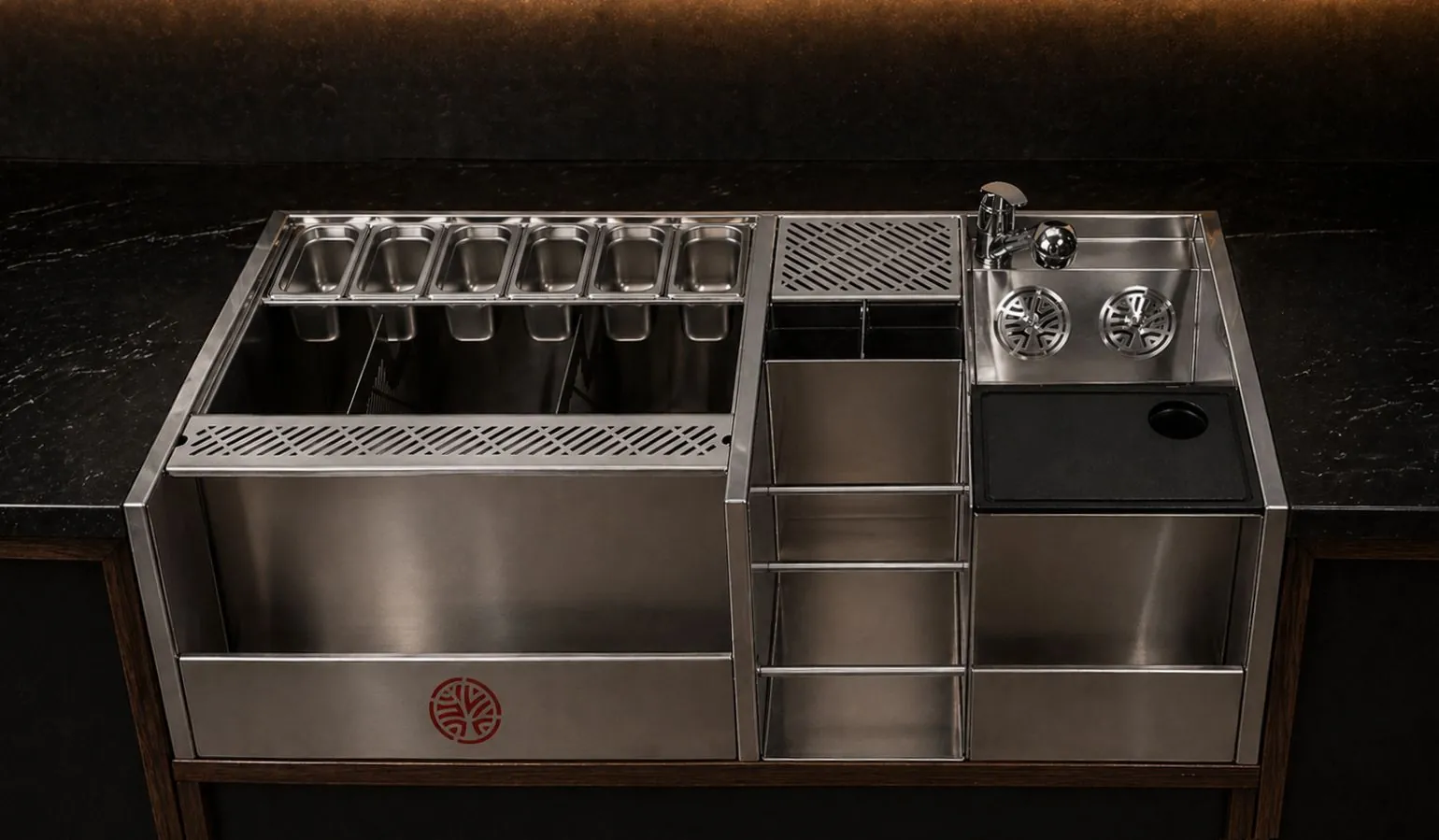
The 7 coffee bar layout types are: single-bay counter, dual-bay parallel, U-shape (horseshoe), island bar, drive-thru, mobile cart, and home coffee bar. Each layout determines equipment density, traffic flow, daily volume ceiling, and barista headcount.
The floor plan locks in every downstream decision: peak drinks per hour, espresso machine group count, milk fridge size, and where the syrup rail sits. Pick the layout to match the volume target, then size equipment to fit.
Standard coffee bar dimensions
Coffee bar working surface 36" high, guest-facing counter 42", working zone depth 24–30", aisle 36" single barista or 42–48" dual barista, underbar depth 24", espresso machine platform at 36" putting steam wand at 50–54", milk fridge 32–36" tall under-counter.
Dimension errors are permanent. An espresso machine platform an inch too tall puts the steam wand in awkward range and burns shoulder muscles by the end of shift. An aisle 4 inches too narrow forces baristas to turn sideways during rush, which kills throughput more than any piece of slow equipment.
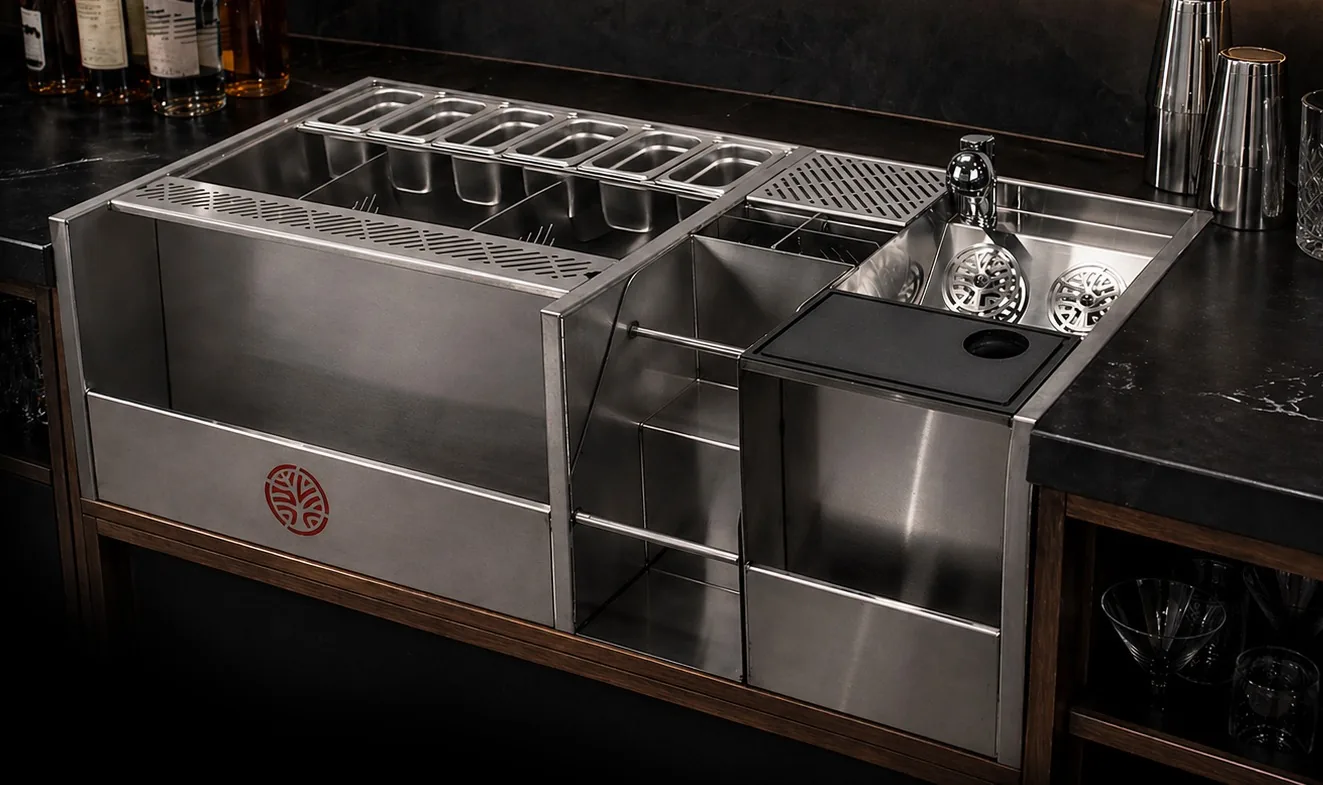
Kobayashi drop-in stations are engineered to the standard 24-inch underbar depth used in cafe build-outs. Available in 52", 65", and 88" to fit single-bay, dual-bay, and high-volume layouts without modification. The 39-inch height places the work surface at the right level for milk pitcher purging directly below an espresso machine platform. Each station also carries a prep faucet that rises about 7.09 inches above the top, if you plan an upper cabinet, shelf, or overhanging bar top above the station, leave clearance for it.
Coffee bar equipment essentials: the complete list
A fully equipped coffee bar needs equipment across six categories: espresso production, grinding, dairy management, ice and cold drinks, water and drainage, and POS. The espresso machine is the largest line item but the underbar stainless steel station ties the workflow together.
Most cafe owners spend 40 percent of their build budget on the espresso machine. Then they pick the rest of the bar piecemeal, a milk fridge from one supplier, a knock box from another, a syrup rack improvised on a shelf. The improvised setup is what kills throughput on a 200-drink Saturday. Spec the stainless underbar first, then the machine drops in.
Espresso machine
The single largest cost. Sizing rule: 1 group head per 30–40 drinks per peak hour. A 2-group machine handles a single-bay cafe; 3-group runs dual-bay or high-volume drive-thru.
Grinders
One dedicated espresso grinder per group head minimum. Add a second for batch brew, decaf, or alternate beans. Place within a quarter-turn of the espresso machine portafilter.
Milk fridge
Under-counter or back-bar, within reach of the steam wand. Daily volume rule: hold 4–6 gallons per 100 drinks, plus alt-milk SKUs (oat, almond, soy).
Milk pitcher rinser
Resets the steam wand and pitcher between drinks in 1 second. Required threshold: any bar producing 30+ milk drinks per hour. Kobayashi stations integrate the rinser at the build position.
Knock box & portafilter rack
Mounted within a 90-degree turn of the espresso machine. The knock box catches spent pucks; the portafilter rack holds clean handles between shots.
Ice well
Required for any cafe serving cold brew, iced lattes, or shaken espresso. Sizing rule: 1 lb of ice per cold drink per hour, plus 25% buffer. The Kobayashi 52" station's 135L ice chest holds 263 lbs usable ice.
Syrup & sauce rail
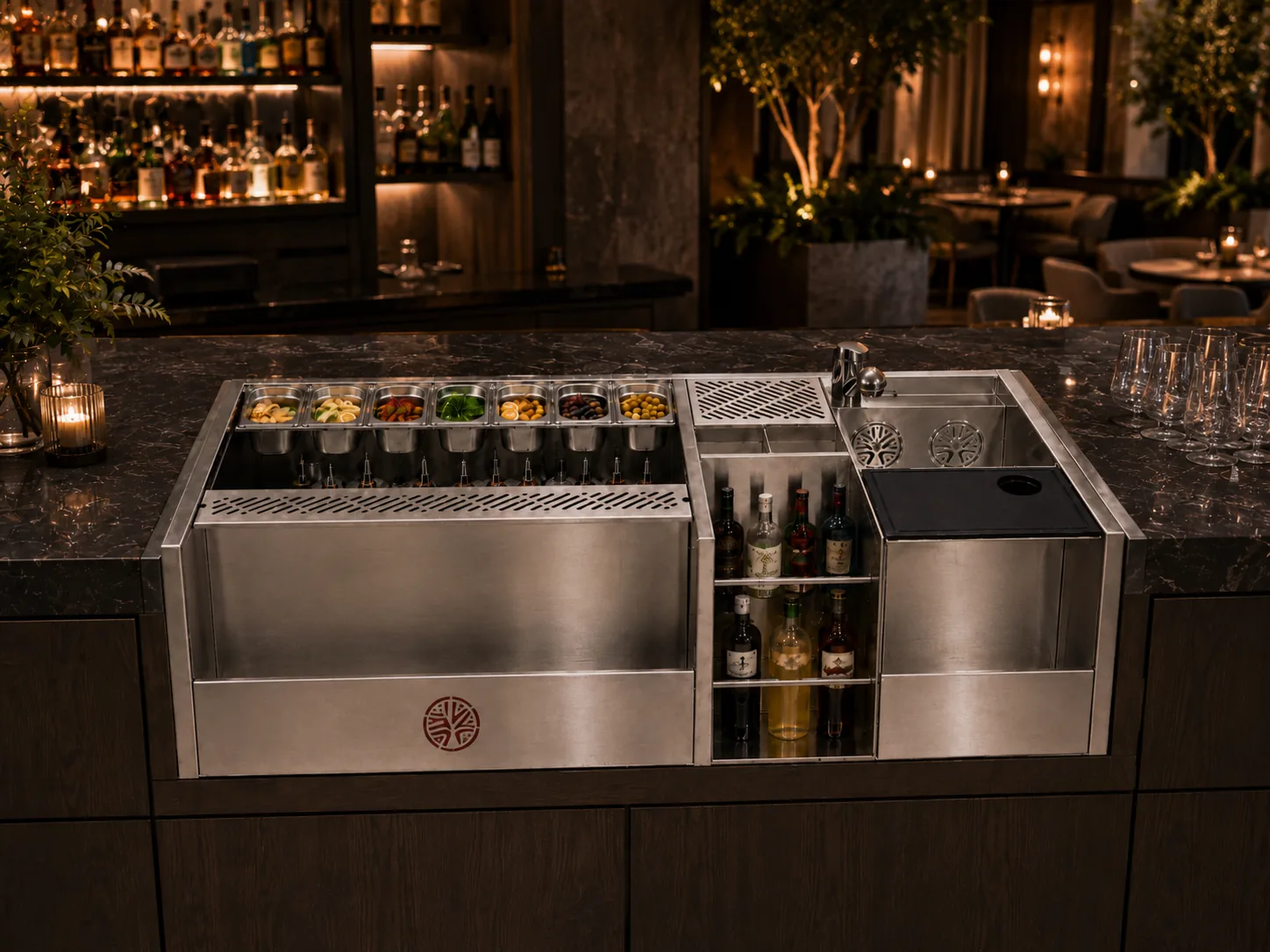
Holds 7–12 pump bottles within arm's reach of the build position. Kobayashi's integrated speed rail repurposes as a syrup rail with the same capacity.
Water filtration & drainage
Required to maintain espresso machine warranty and prevent scale. Floor drain under the espresso machine and station. Connect station drain to floor drain via 1" NPT.
POS terminal
Within reach of every barista's primary build position. A slow POS costs as much throughput as a misplaced grinder.
Every piece of underbar equipment connects to the Kobayashi station. The integrated ice well supplies cold drinks. The milk pitcher rinser sits at the build position. The speed rail becomes a syrup rail. The drain routes through one outlet. Spec the station first, then size the espresso machine and grinders to fit. Get a free design consultation, our team specs the station against your daily volume target.
The coffee bar underbar: stations, rinsers, and ice wells
The coffee bar underbar is the integrated equipment assembly that forms the barista's working zone. It consists of the stainless steel base station, milk pitcher rinser, ice well, syrup rail, and drain, all positioned to keep the barista in build position for 90 percent of drinks.
Kobayashi coffee bar stations
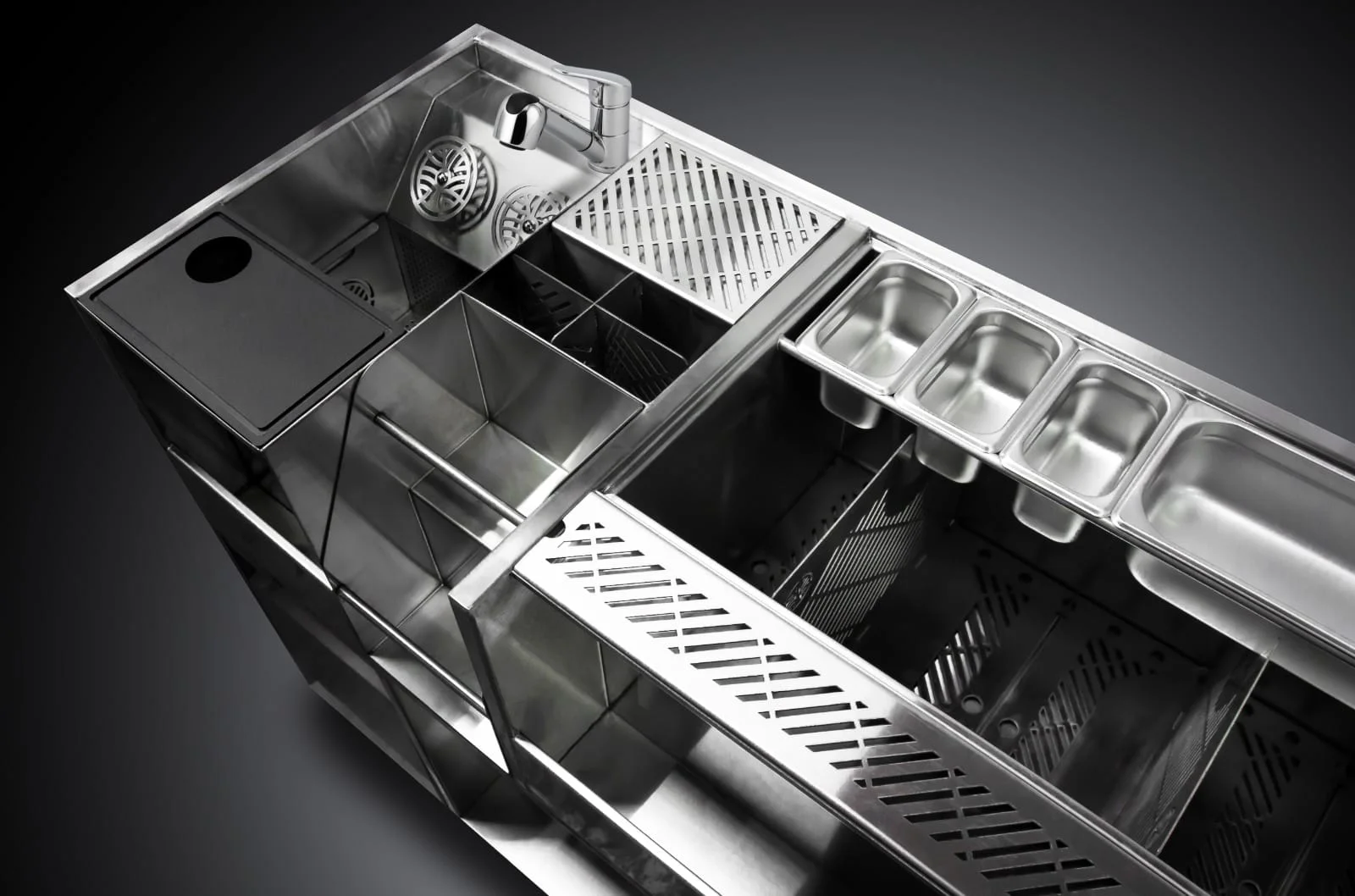
The base station is the production center. It integrates the milk pitcher rinser, ice well, and syrup rail into one unit so the barista can rinse, pour, and dispense without taking a step. A properly sized station handles 80 to 90 percent of drink builds from a single standing position. The same hardware that runs a craft cocktail program runs a craft coffee program.
How to design the barista working zone
The barista working zone is the 24-inch arc in front of the espresso machine, between the build position and the back-bar storage. An efficient zone positions grinder, knock box, steam wand, milk pitcher, ice well, and syrup rail within reach, eliminating step-based time loss during drink production.
The barista's triangle: espresso machine at one point, grinder at another, milk fridge at the third, with the build tray at the center. Every inch added to the triangle is a lost second per drink, and at 200 drinks a day, lost seconds add up to lost shifts.
Working zone layout (left to right, right-handed setup)
Grinder
Quarter-turn left of espresso machine. Portafilter reaches grinder in one motion.
Espresso machine & portafilter rack
Center, mounted on a 36-inch platform. Steam wand on the right group head for right-handed pours.
Knock box
Directly below or beside the grinder. Empty pucks land within a quarter-turn of the portafilter knock motion.
Milk pitcher rinser
Right of steam wand. Reachable without leaving build position.
Milk fridge
Under-counter, accessed with a half-turn. Holds 4–6 gallons per 100 drinks plus alt-milk SKUs.
Ice well & syrup rail
Within the Kobayashi station footprint, build-position side. Syrup rail held 7–12 pump bottles.
POS terminal
Far right or angled, within a single body turn. Slow POS = lost throughput.
Kobayashi drop-in and standalone stations are built around the barista triangle principle. The integrated speed rail (used here as syrup rail), ice well, and stainless work surface consolidate three primary production points into one 52", 65", or 88" unit, eliminating the ad hoc placement decisions that fragment workflows in coffee bars built from off-the-shelf parts.
Coffee bar design ideas: 8 directions that work
Coffee bar design ideas fall into 8 working directions: minimal Scandinavian, warm rustic farmhouse, industrial cafe, modern Italian, Japanese kissaten, third-wave coffee shop, kitchen-integrated home bar, and basement entertainment bar. Each direction sets a different material palette around the same 304 stainless underbar core.
Most coffee bar visuals share two truths: the espresso machine is hero, and the stainless underbar is what makes it functional. Everything in front of the bar (the wood, the brass, the tile, the lighting) is the brand. Everything behind the bar (the rinser, the syrup rail, the ice well) is the workflow. The two layers compose independently.
Minimal Scandinavian
Light oak counter front, white quartz top, stainless underbar visible at the joints. Espresso machine in matte black or pearl white. Pendant lights in oxidized brass. Single shelf of ceramic cups above the machine. Reads as elevated daily ritual. Best for boutique cafes in design-led neighborhoods.
Warm rustic farmhouse
Reclaimed pine or walnut counter front. Live-edge bar top. Stainless underbar tucked behind a wood apron. Espresso machine in burnished copper or unlacquered brass. Antique signage. Pour-over station with chemex and v60 visible. Best for converted-mill cafes and farm-to-table coffee programs.
Industrial cafe
Exposed brick or polished concrete walls. Black steel structure. Stainless underbar exposed and brushed to a matte grain. Espresso machine matte black or gunmetal. Edison-bulb pendants. Visible plumbing as design feature. Best for warehouse conversions and tech-district coffee bars.
Modern Italian
White marble or Calacatta bar top. Stainless underbar polished to a mirror finish. Lever or piston espresso machine (La Marzocco Strada, Slayer V3) as centerpiece. Brass or chrome detailing. Glass shelving with vintage Bialetti and demitasse cups. Best for espresso-forward programs that lean Milan rather than Melbourne.
Japanese kissaten
Dark walnut counter, white plaster walls, soft warm pendant. Stainless underbar finished with a satin pattern. Single-origin pour-over as ritual. Drip kettle, hourglass timer, brass scale. Indirect lighting only. Best for slow-coffee programs that compete on craft rather than speed.
Third-wave coffee shop
Light wood or plywood counter, light-tone walls, exposed copper plumbing. Stainless underbar brushed and visible. Single-origin chalkboards. Glass cake domes for pastries. Mid-century stools. Espresso machine in white or pastel. Best for the Blue Bottle / Stumptown aesthetic.
Kitchen-integrated home coffee bar
Drop-in Kobayashi 52" station into an existing kitchen island or 24-inch counter run. Espresso machine on top of the stainless work surface. Open shelving for cups. Milk fridge as under-counter beverage center. Reads as a serious-home-coffee corner without taking over the kitchen. Best for daily home espresso rituals.
Basement entertainment bar with coffee corner
Convert a basement bar into dual-purpose: cocktails at night, coffee in the morning. The Kobayashi standalone station holds milk pitcher rinser, ice well for cold brew, and syrup rail in the same 52-inch footprint that holds the speed rail and glass rinser for cocktails. One station, two programs, swapping bottles takes 10 minutes. Best for entertainers who actually use the basement bar daily.
Common across all 8 directions
Every direction above uses 304 stainless as the underbar. The front-of-bar aesthetic changes; the workflow hardware does not. That's the design freedom that comes from specifying a tested production hub first and styling the cabinetry around it.
12 proven coffee bar configurations
These configurations reflect what cafe owners and architects spec across the most common coffee bar contexts. Each includes a Kobayashi equipment call-out because underbar spec is where most cafe builds run over budget or hit workflow problems.
01: Boutique cafe single-bay (8–12 ft)
Kobayashi 52" drop-in. 2-group espresso. Single grinder, single batch brew. Ice well for cold brew. Syrup rail for 7 bottles. Aisle 36".
02: High-volume cafe dual-bay (14–20 ft)
Kobayashi 65" drop-in. 3-group espresso. Two grinders. Dual milk fridges. 12-bottle syrup rail. Aisle 48". 200+ drinks/peak hour.
03: Hotel lobby coffee bar (island)
Standalone stations on two faces. Espresso on one, pour-over on the other. Pass-through milk fridge. Aisle 48".
04: Drive-thru coffee window
Linear 65" drop-in, drive window at one end. Simplified syrup rail. Fast-rotation milk. POS at the window.
05: Restaurant coffee program
Kobayashi 52" drop-in adjacent to kitchen pass. Espresso machine, single grinder. Tea station integrated. Under-counter milk fridge.
06: Mobile coffee cart
52" standalone portable station with castors. Integrated water + waste tanks. Electric pump. Portable espresso machine. Events, popups.
07: Multi-roaster third-wave shop
Kobayashi 65" drop-in. Manual brewing station: V60, chemex, kalita. Multiple grinders for single-origin rotation. Pour-over scales built in.
08: Cafe-bar dual-program (coffee+cocktails)
Kobayashi 52" drop-in. Same station holds espresso syrups by day, cocktail bitters by night. Ice well covers both. One build cost, two programs.
09: Grab-and-go retail coffee counter
Linear 52" drop-in. Super-automatic espresso machine. Pre-batched cold brew on tap. POS forward. Designed for transactions under 90 seconds.
10: Specialty coffee tasting room
Kobayashi 52" standalone. Manual brewing centered, espresso secondary. Tasting glassware shelf above. Slow-coffee ritual program.
11: Office coffee bar (corporate)
Kobayashi 52" drop-in into a kitchen counter. Super-automatic or 2-group. Bean hopper. Under-counter milk fridge. Pod waste station.
12: Home coffee bar (kitchen integrated)
Kobayashi 52" drop-in into a 24" kitchen counter. Prosumer espresso machine on top. Under-counter milk fridge. Integrated syrup rail for vanilla, caramel, hazelnut.
The coffee bar design process, step by step
Coffee bar design follows 8 sequential steps: define drink program, establish floor plan and utilities, spec working zone dimensions, select espresso machine and grinders, spec the stainless underbar station, plan milk and syrup organization, plan plumbing and drain, then execute construction, plumbing first, equipment last.
Coffee bar design failures are almost always sequencing failures. A counter built before the espresso machine was specified leaves the steam wand at an awkward height. A drain forgotten until permit review costs four weeks. A milk fridge placed without considering the steam wand reach burns shoulder muscles by week three.
Define the drink program
Espresso-forward, batch brew, pour-over, full cafe with food, or grab-and-go? The drink program determines bar length, equipment density, and barista headcount.
Establish the floor plan
Measure the space. Identify water supply, floor drains, 220V electrical for the espresso machine. Choose single-bay, dual-bay, or U-shape based on shape and volume target.
Spec working zone dimensions
Counter 36", guest-facing 42", working zone depth 24–30", aisle 36–48", underbar 24". Espresso machine platform 36", steam wand 50–54".
Select the espresso machine and grinders
Match group head count to peak drinks per hour. One group per 30–40 drinks/hour. Add a second grinder for batch brew or decaf.
Spec the underbar stainless station
Choose Kobayashi 52", 65", or 88" based on working zone length. Integrated milk pitcher rinser, ice well, and syrup rail consolidate three workflow zones into one 304 stainless unit.
Plan milk, ice, and syrup organization
Milk fridge within a half-turn of espresso machine. Ice well within reach for cold drinks. Syrup rail at build position.
Plan plumbing and drain
Water to espresso machine, rinser, and ice well. Espresso drain through the underbar station drain to floor drain. Backflow preventer required by most AHJs.
Execute construction in sequence
Rough plumbing and electrical first. Framing and cabinetry. Underbar station drop-in after cabinets. Espresso machine install. Final finish.
Home coffee bar design: kitchen and basement build-outs
Home coffee bars fall into three build types: kitchen-integrated, basement entertainment bar, and dedicated coffee corner. Each uses the same Kobayashi 52" drop-in or standalone station, just installed differently.
Kitchen-integrated. Drop the Kobayashi 52" drop-in into a standard 24-inch deep kitchen counter run. Place the espresso machine on the stainless work surface. Use under-counter cabinetry for the milk fridge. Open shelving above for cups. The stainless is a working surface and a wipeable backsplash at the same time.
Basement entertainment bar. Use the standalone 52" instead of the drop-in. The station holds milk pitcher rinser and ice well for cold brew during the day, swaps to glass rinser and ice for cocktails at night. Same 304 stainless hardware, different liquids. One bar, two programs.
Dedicated coffee corner. A 5 by 6 foot alcove in a hallway or off the kitchen. Standalone 52", espresso machine on top, milk fridge below. Pour-over kettle on a shelf. Light pendant above. Reads as serious-coffee ritual without taking over another room.
The construction-grade 304 stainless that runs a 200-drink commercial cafe is the same hardware that runs a 4-drink Saturday morning at home. It will outlive the espresso machine, the kitchen, and possibly the house.
Frequently asked questions
The standard coffee bar height is 42 inches on the guest-facing side to match counter-height stool seating. The barista working surface behind the bar runs 36 inches high for comfortable standing operation. Espresso machine platforms typically sit on the 36-inch working surface, putting the steam wand and group heads at roughly 50 to 54 inches.
A coffee bar requires an espresso machine, grinder (dedicated for espresso, often a second for batch), milk fridge, knock box, water filter, syrup or sauce rail, garnish station, ice well for cold drinks, milk pitcher rinser, three-compartment or commercial dishwasher, POS terminal, and a pour-over or batch brew setup if served. A 304 stainless steel base station ties the rinser, ice well, and syrup rail together in one footprint.
Choose the 52-inch station for cafes serving up to 120 guests per day or boutique coffee shops. The 65-inch station fits multi-bay coffee bars or 120 to 170 guest counts. The 88-inch station suits high-volume cafes, hotel coffee bars, or operations running two baristas in parallel. All three are 304 stainless steel with integrated ice well, milk pitcher rinser, and syrup rail.
A single-barista coffee bar workflow needs a 30 to 36-inch deep working zone behind the espresso machine, with the grinder, knock box, and steam wand within a 24-inch reach. A two-barista bar needs 42 to 48 inches of aisle behind the working zone so staff can pass back-to-back during peak rush. Total counter length for a single-bay setup is 8 to 12 feet; multi-bay setups run 16 to 24 feet.
A coffee bar syrup rail is a raised ledge or holder on the barista working surface that organizes flavored syrups, sauces, and pump bottles within arm's reach of the build position. In a Kobayashi station, the integrated speed rail repurposes as a syrup rail with capacity for 7 to 12 bottles, keeping the barista in build position for 90 percent of drinks.
The best material for a commercial coffee bar working surface is 304 stainless steel. It resists corrosion from coffee oils, milk acid, citric acid in espresso shots, and chlorinated sanitizers. Stainless is non-porous, so milk residue and coffee oil cannot penetrate the surface, and it survives 15 to 20 years of daily wiping with espresso machine cleaner.
Yes. The Kobayashi 52-inch drop-in station integrates into a home kitchen counter or basement bar cabinet at standard 24-inch underbar depth, providing milk pitcher rinsing, ice for cold brew, and syrup organization in a single 304 stainless unit. Standalone 52-inch units work for freestanding home coffee corners and convert between coffee and cocktail use without modification.
A commercial coffee bar costs $20,000 to $120,000 to build depending on size, location, and equipment grade. The espresso machine is the largest single cost at $8,000 to $30,000. Underbar stainless steel equipment (cocktail station, rinser, ice well, syrup rail) runs $5,500 to $9,000. Plumbing, electrical, cabinetry, and finish work account for the balance.