A sports bar lives or dies in the first 12 minutes of the third quarter. That's when 200 thirsty regulars all decide they want another round at the same time. Get the underbar layout, tap-wall configuration, and ice supply right and four bartenders push 300 drinks in 60 minutes. Get it wrong and ticket times stretch to 8 minutes per build because someone keeps stepping past the speed rail to reach the glycol cooler.
This guide covers sports bar design from the ground up: seven layout types with real equipment specs, dimensions that move 300-drink rushes, the equipment essentials every game-day venue needs, big-screen sight lines and zoned audio, 12 proven configurations, and how Kobayashi's 304 stainless underbar stations support the highest-volume programs in the country.
Kobayashi Bar manufactures 304 stainless steel bar stations, drink rails, glass rinsers, and integrated speed rails in the USA. The same hardware that runs a Michelin cocktail program survives a 12-hour Bears-Packers Sunday. Need help designing a sports bar? Our design team consults free for one hour on every quote.
What is a sports bar?
A sports bar is a high-throughput beverage venue built around live televised sports, with the bar designed to push 150 to 350 drinks per peak hour during major broadcasts. Sports bars range from 1,200-square-foot neighborhood taverns with 4 screens to 10,000-square-foot mega-venues with 50+ screens, video walls, draft tap walls, and dedicated server stations.
Most bar designs balance aesthetics with throughput. Sports bars are different: the design has to survive a 90-minute window where 200 people simultaneously want a beer and the fries arrive. Every dimension, every piece of equipment, every drain placement exists to keep four bartenders moving without colliding.
Sports bars need 304 stainless steel underbar surfaces because they get hit harder than any other format. Beer foam, soda gun overspray, citrus, bleach sanitizer, and constant wiping all attack the working surface. Stainless ignores them. Wood and laminate fail within 18 months.
A neighborhood sports bar produces 120 to 200 drinks per peak hour. A premium game-day venue with 4 bartenders pushes 250 to 350. Every floor plan dimension supports keeping bartenders within a 2-foot working radius for 90 percent of drink builds.
Every seat in a sports bar must see at least one screen without rotating the head more than 30 degrees. Screens are positioned first; the bar plan follows. Bar back walls are screen walls. The bar top depth and stool height are calibrated to the screen heights above.
Commercial-grade stainless steel sports bar hardware is rated for 15 to 20+ years of daily use including Sunday rushes. Mid-grade equipment under sports bar volume fails in 3 to 5 years. The replacement cost erases up-front savings on the first cycle.
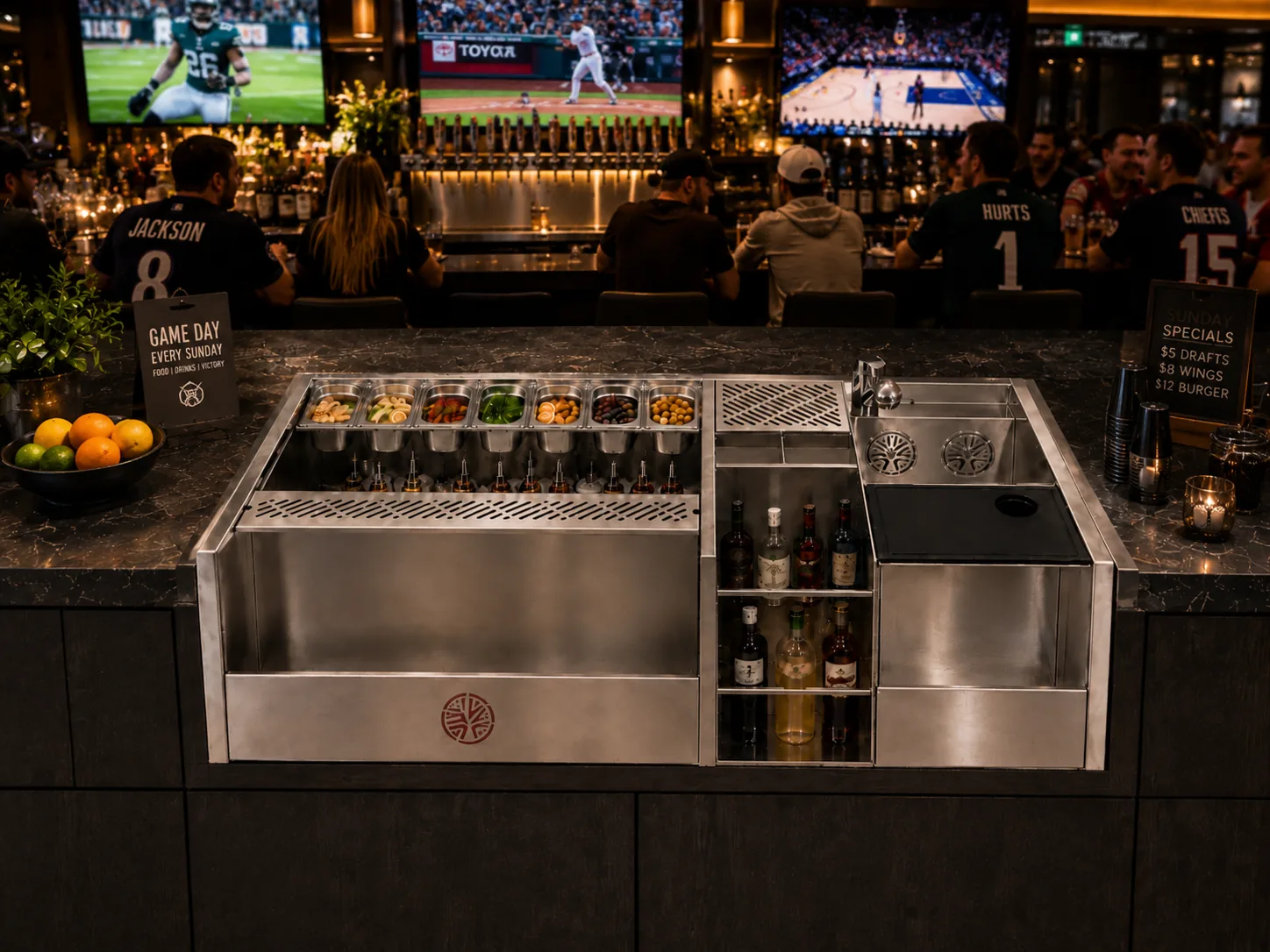
The 7 sports bar layout types
The 7 sports bar layout types are: linear single-wall, L-shape, U-shape (horseshoe), island bar, video-wall focal, taphouse linear, and stadium-tier multi-level. Each determines screen count, draft system size, bartender headcount, and seating capacity.
The bar floor plan locks in everything else. Pick the layout based on screen plan and seating target. Underbar equipment sizes to peak-hour drink count. The mistake is sizing the bar to square footage instead of sizing it to the busiest 90 minutes of the week.
Standard sports bar dimensions
Sports bar top 42" guest-facing, 36" working, working zone depth 18–24", aisle 42–48" for two bartenders, underbar 24", foot rail 8–10" off floor. Bar top depth 16–18" guest, 18–24" working. Total bar length 12–18 ft (neighborhood), 18–30 ft (mid-size), 30–60+ ft (premium game-day venues).
Dimension errors are unforgiving in sports bars. An aisle four inches too narrow forces bartenders sideways past each other during a rush; lost throughput in the third quarter erases the construction cost savings inside a season. A working surface an inch too low ruins shoulders on 10-hour shifts.
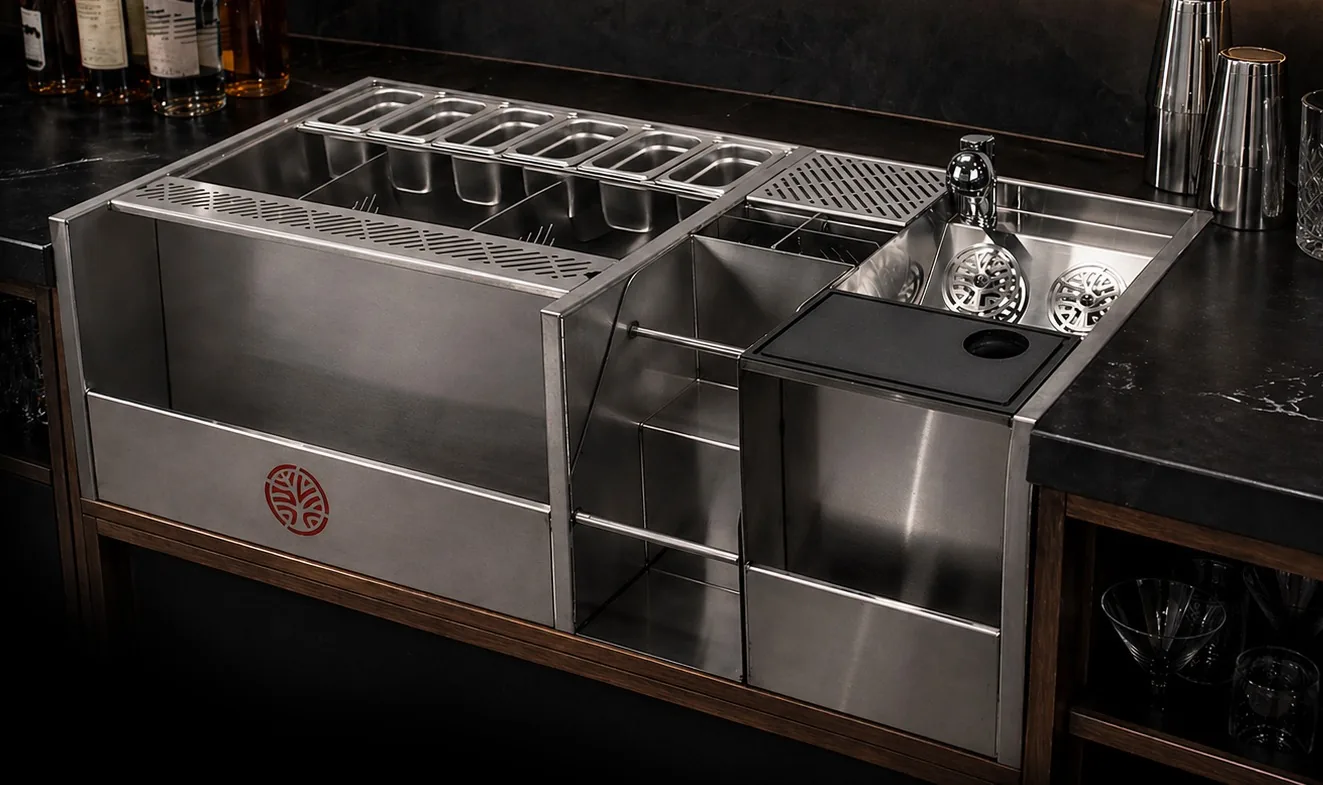
Kobayashi drop-in stations are engineered to the standard 24-inch underbar depth used in commercial sports bar build-outs. Available in 52", 65", and 88". The 88" handles the highest-volume game-day venues with a 168L ice chest holding 328 pounds of usable ice and a 12-bottle integrated speed rail. Each station also carries a prep faucet that rises about 7.09 inches above the top, if you plan an upper cabinet, shelf, or overhanging bar top above the station, leave clearance for it.
Sports bar equipment essentials: the complete list
A fully equipped sports bar needs equipment across six categories: production, refrigeration, draft beer, ice and dispensing, glass management, and AV. The draft system and screen install are the most visible; the underbar stainless is what moves the actual drinks.
Most sports bar builds blow budget on screens and tap handles, then run out of capital before the underbar gets specified. That's exactly backward. Screens drive traffic in; the underbar drives ticket times. Both need to clear during the same Sunday rush.
Cocktail station
The hub. Sizing rule: 65" drop-in for mid-volume; 88" for high-volume venues running 250+ drinks per peak hour. Integrated 168L ice chest, 12-bottle speed rail, dual rinser cutouts.
Beer tap wall
8 to 24 taps. Direct-draw under 10 feet to keg cooler; glycol cooling for longer runs. Drip tray full length of tap wall, connected to floor drain through the bar drainage system.
Commercial ice maker
The Sunday throughput killer if undersized. Sizing rule: 1 to 1.5 lbs per drink per peak hour, plus 20% buffer. 500+ lbs/day minimum for high-volume venues.
Soda gun & cold plate
Cuts mixer pour time from 4–6 seconds (bottle) to under 1 second (gun). Over a 300-drink rush that's 25 minutes recovered per bartender.
Back bar coolers
Beer, wine, pre-batched cocktails. Plan distinct temperature zones. Glass-front doors face guests; opaque doors face the kitchen run.
Glass rinsers (dual)
Two minimum on the 65"+ stations. Reset glassware in 1 second. Cuts time per drink by 4–7 seconds vs. carrying glasses to the dishwasher.
Commercial dishwasher
90–120 second cycle. Mandatory for any sports bar washing pint glasses in-house at volume.
POS terminals (multiple)
One within reach of every primary bartender station. A slow POS at the underbar adds 8 seconds per ticket; on Sunday that's an extra 40 minutes of accumulated wait.
Screens & audio system
Wire HDMI from a central distribution amp. Zone audio so different games play in different sections. Plan during framing, not as an upgrade.
Every piece of underbar equipment above connects to the Kobayashi station. The integrated 168L ice chest supplies the soda gun cold plate, dual rinsers, and drink builds. The 12-bottle speed rail sits within the station frame. The soda gun holster mounts to the station edge. The drain system routes through one outlet. Spec the station first, then size the ice maker, taps, and coolers to fit. Get a free design consultation, our team specs the station against your peak-hour drink count.
The sports bar underbar: stations, rails, and rinsers
The sports bar underbar is the integrated equipment assembly that forms the bartender's working zone. It consists of the cocktail station, speed rail, ice chest, glass rinser, drink rail, and drain, all positioned so a bartender can build a beer + shot in under 8 seconds without taking a step.
Kobayashi sports bar stations
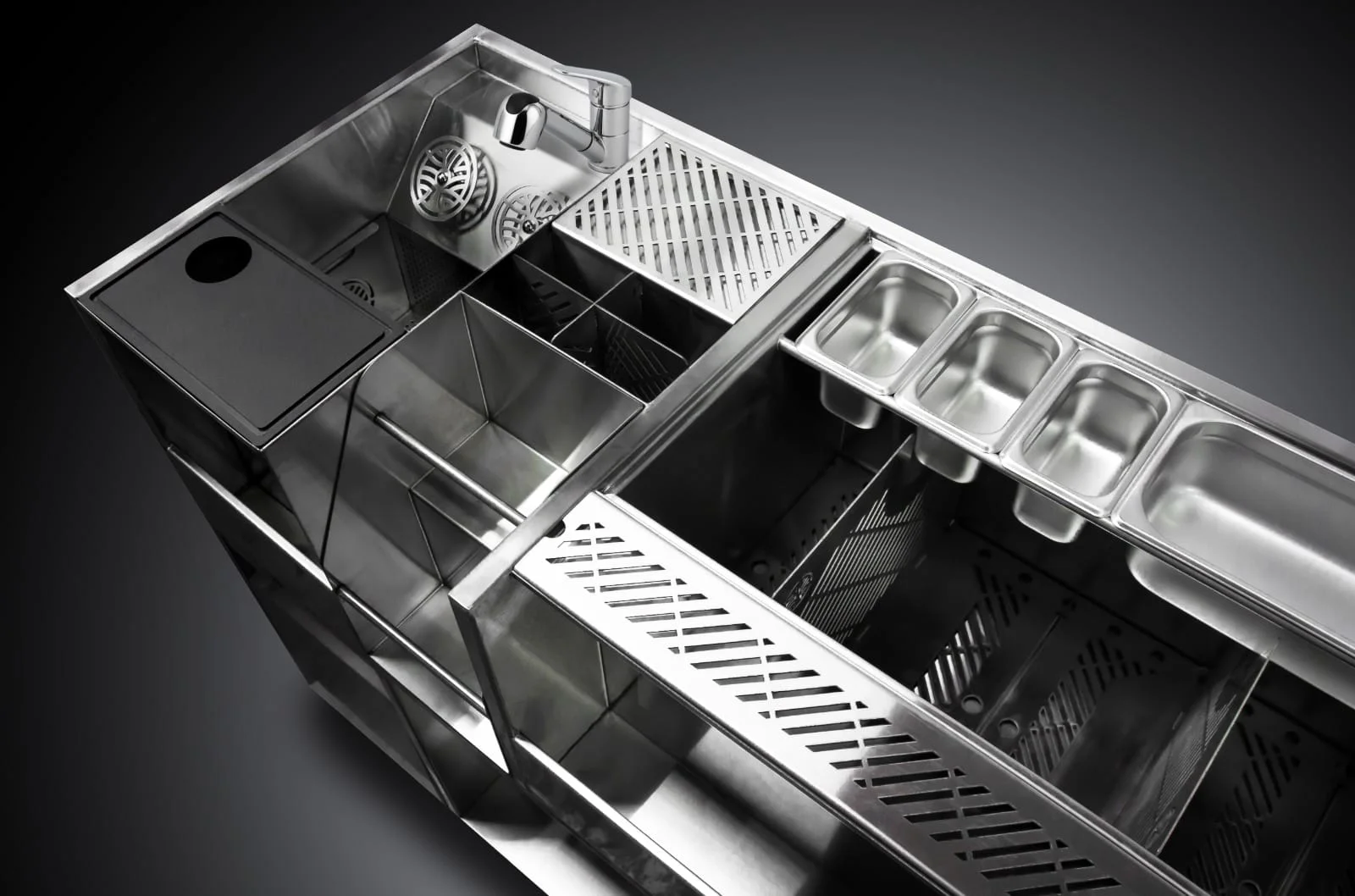
The cocktail station is the production hub. It integrates the 12-bottle speed rail, 168L ice chest, and dual glass rinsers into one 88-inch unit so a bartender can pour from rail, ice a glass, rinse the next, and ring it up without leaving build position. A properly sized 88" station handles 80 to 90 percent of drink builds from a single standing position during a 300-drink rush.
How to design the bartender working zone for high volume
The sports bar working zone is the 18–24" deep area in front of the bartender, between the drink rail and the back of the underbar equipment. An efficient zone positions ice, spirits, taps, and rinsers within a 2-foot radius, eliminating step-based time loss during 300-drink rushes.
The bartender's triangle: ice at one point, spirits at another, mixing tools at the third, with the glass at the center. Every inch added to the triangle is a lost second per drink, and at 300 drinks per peak hour, lost seconds erase 30 minutes of accumulated wait.
Working zone layout (left to right, right-handed setup)
Glass storage
Below or behind the bartender, within a 90° turn. Pints, rocks glasses, shot glasses pre-stacked.
Ice chest and speed rail
Center-front, within the cocktail station footprint. 12 bottles within arm's reach.
Cocktail station / mixing area
Direct front, the workhorse 18–24" deep zone where drinks build.
Glass rinsers (dual)
Right and left of the ice well; both reachable from the build position.
Soda gun
Holster mounted to the station edge, neutral wrist position. Cold plate behind.
Beer taps
On the back-wall tap wall, 8 to 24 handles. Drip tray below catches all overflow.
POS terminal
Far right or angled, within a single body turn. Multiple POS for multi-bartender stations.
Kobayashi drop-in and standalone stations are built around the bartender's triangle principle. The integrated 12-bottle speed rail, 168L ice chest, and dual rinsers consolidate the three primary production points into one 65" or 88" unit, eliminating ad hoc placement decisions that fragment working zones in sports bars built from off-the-shelf parts.
Sports bar design ideas: 8 directions that work
Sports bar design ideas fall into 8 working directions: classic American neighborhood tavern, premium game-day venue, taphouse industrial, sports book casino style, esports lounge, Irish pub sports bar, Mexican cantina sports bar, and rooftop sports bar. Each sets a different material palette around the same 304 stainless underbar core.
Most sports bar visuals share two truths: the screens are hero, and the stainless underbar is what makes it survive volume. Everything in front of the bar (the wood, the brass, the leather, the lighting) is the brand. Everything behind the bar (the speed rail, the rinser, the ice well, the taps) is the workflow. The two layers compose independently.
Classic American neighborhood tavern
Dark oak counter front, brass foot rail, vintage pennants on the walls. Stainless underbar visible at the joints. Edison bulb pendants. 6 to 8 screens evenly spaced. 6 to 12 taps. Reads as the kind of bar that's been there for decades. Best for converted spaces in established neighborhoods.
Premium game-day venue
Polished walnut and leather. Brushed stainless underbar with mirror-finish kickplate. 16+ screens including a single massive video wall as the focal point. 12 to 24 taps. Tiered seating. Audio zoning. Reads as the place season-ticket holders go after the game. Best for upscale destinations and stadium-adjacent venues.
Taphouse industrial
Exposed brick walls, polished concrete floors, black steel structure. Stainless underbar exposed and brushed to a matte grain. 24+ tap wall as the back-bar centerpiece, chalk-board beer list. Edison bulbs, visible glycol lines as design feature. Best for craft-beer-forward sports venues in warehouse conversions.
Sports book casino style
Rich burgundy and gold palette. Polished mahogany bar front. Stainless underbar polished mirror. Multiple individual screen banks plus video wall. Live odds board integrated. Aisle space for VIP service. Best for legal sportsbook markets and casino integrations.
Esports lounge
Dark walls, RGB accent lighting, gaming-aesthetic neon. Stainless underbar visible. Dedicated gaming PCs at booths visible from bar. Multiple curved screens. Streaming-quality audio. Energy drink cooler integrated. Best for college towns and tech-district sports venues.
Irish pub sports bar
Reclaimed dark wood paneling, brass details, vintage Guinness signage. Snug booths along the wall. Stainless underbar tucked behind a wood apron. 6 to 10 taps with stout central. 4 to 8 screens. Best for traditional Irish pub conversions doing major-league sports.
Mexican cantina sports bar
Talavera tile accents, hand-painted signage, warm terracotta. Brushed stainless underbar visible. Tequila wall as back-bar focal alongside screens. 6 to 12 taps featuring Mexican beers. Outdoor patio extension for futbol nights. Best for soccer-forward Latin American sports programs.
Rooftop sports bar
Open-air or retractable-roof. Stainless standalone stations rated for outdoor use. Marine-grade fasteners. Wind-secured screens. Heat lamps and fire pits for shoulder season. Massive video wall protected behind glass or rolled in. Best for warm-climate venues with strong skyline real estate.
Common across all 8 directions
Every direction above uses 304 stainless as the underbar. The front-of-bar aesthetic changes; the workflow hardware does not. That's the design freedom that comes from specifying a tested production hub first and styling the room around it.
12 proven sports bar configurations
These configurations reflect what sports bar operators and bar builders spec across the most common venue contexts. Each includes a Kobayashi equipment call-out because underbar spec is where most sports bar builds either survive their first Sunday rush or fail it.
01: Neighborhood linear sports bar (12–18 ft)
Kobayashi 65" drop-in. Full-length drink rail. Single rinser adjacent to ice. 8 taps direct-draw. 6 to 8 screens. Aisle 36".
02: High-volume game-day venue (18–30 ft)
Kobayashi 88" drop-in. 12-bottle speed rail. Dual rinsers. 16 to 24 taps with glycol. 12 to 16 screens. Two POS. Ice maker 500+ lbs/day.
03: Sports bar with video-wall focal
88" drop-in opposite a 16-foot LED video wall. Tiered seating. Single primary game on the wall, secondary games on side screens. Audio zoned.
04: Taphouse sports bar (24+ taps)
Kobayashi 88" drop-in. 24-tap wall backing the bar. Full-length drip tray. Glycol cooling. 8 to 12 screens. Beer-forward menu.
05: Restaurant-attached sports bar
Kobayashi 65" drop-in with one arm into the dining room. Pass-through to kitchen. 6 to 8 screens visible from both bar and dining sides.
06: U-shape stadium-tier bar
Three drop-in stations around a U-shape. 20+ screens overhead. Center video wall. 4 bartenders. Capacity 300+ drinks/peak hour.
07: Sports book casino bar
Kobayashi 88" drop-in. Live odds board integrated. Multiple screen banks for parallel games. VIP service line. POS with bet-and-drink integration.
08: Island sports bar (4-side service)
Standalone stations on two faces. 360-degree screen ring above. Aisle 48" around perimeter. Best for large open-floor venues.
09: Rooftop sports bar (outdoor)
Stainless standing stations, open-frame. All hardware 304 or marine-grade. Floor drains for rain. Retractable roof or fixed structure. Weather-rated screens.
10: Sports book + dining venue
Kobayashi 88" drop-in. Separated dining and bar sections. Quiet-zone audio. Premium menu. Bar serves dining ticket overflow.
11: Stadium concourse sports bar
Linear 88" drop-in. Limited menu, max throughput. Two bartenders during halftime, four during major event. Ice maker 600+ lbs/day.
12: Esports lounge bar
Kobayashi 65" drop-in. Energy drink cooler integrated. Curved screen wall facing gaming PCs. Audio zoning for stream + bar separation.
The sports bar design process, step by step
Sports bar design follows 8 sequential steps: define venue type, plan screens and sight lines, establish floor plan and utilities, spec working zone dimensions, select underbar stainless equipment, spec the draft system, plan AV and zoned audio, then execute construction, plumbing and AV conduit first, screens and equipment last.
Sports bar design failures are sequencing failures. A bar built before screens were positioned leaves dead-zone seats with no view. A draft system specified after the bar was framed has no path for glycol lines. AV conduit run after drywall is a six-week change order.
Define the venue type
Neighborhood tavern, premium game-day venue, hotel sports bar, casino sports book, taphouse, esports lounge? The venue type determines screen count, draft system size, bartender headcount, and floor plan.
Plan screens and sight lines
Every seat must see at least one screen without rotating the head more than 30 degrees. Plan TV placement and a video wall (if any) before the bar plan. Bar back walls are screen walls.
Establish the floor plan and utilities
Measure the space. Identify water supply, floor drains, electrical panels, and ceiling structure for AV conduit. Locate the keg cooler.
Spec working zone dimensions
Bar top 42" guest, 36" working, working zone depth 18–24", aisle 42–48" for two bartenders, underbar 24".
Select underbar stainless equipment
Choose Kobayashi 65" or 88" station based on peak-hour drink count. Spec 168L ice chest, 12-bottle speed rail, dual rinsers.
Spec the draft system
Count taps (8 to 24). Direct-draw under 10 feet to keg cooler. Glycol cooling for longer runs. Drip tray full-length under tap wall. CO2 and N2 lines.
Plan AV and zoned audio
HDMI runs from central distribution to every TV. Zone audio for multiple games. Ceiling speakers, subwoofers, dedicated quiet zone. All wiring during framing.
Execute construction in sequence
Rough plumbing and electrical first. Framing with AV conduit and glycol lines. Bar cabinetry. Underbar station drop-in. Tap wall and screens. POS and final commissioning.
Screen placement, sound zoning, and AV design
Sports bar AV is the difference between a venue that fills for every major game and one that doesn't. Three principles drive every AV decision: sight lines, audio zoning, and feed redundancy.
Sight lines. Every seat in the bar must see at least one screen without rotating the head more than 30 degrees. Walk every seat after framing and before drywall. If you can't comfortably watch a screen from a stool, move the screen, move the stool, or add another screen. Don't open the bar with dead-zone seats.
Audio zoning. Major-game viewers want to hear announcers. Casual diners don't. Zone the audio so different sections hear different feeds: bar area gets primary game audio, dining area gets ambient music or a different game, patio gets the quiet zone. Ceiling speakers per zone with independent volume control. A central audio matrix routes feeds.
Feed redundancy. Sports bars run on multiple satellite or streaming subscriptions in parallel: DirecTV Sunday Ticket, ESPN+, regional sports networks, international soccer feeds. Have at least two independent providers wired to the AV matrix. When one feed drops at kickoff, the other takes over.
Equipment behind the bar. The AV rack lives in the back-of-house or a wall-mounted enclosure away from spills, not behind the bar where it gets dripped on. Run HDMI through conduit during framing. Wiring after drywall is a six-week change order.
Frequently asked questions
A neighborhood sports bar runs 1,200 to 2,500 square feet with a linear bar of 12 to 18 feet. A mid-size sports bar with multiple TV walls runs 3,000 to 6,000 square feet with a bar of 18 to 30 feet. A large multi-screen sports venue runs 6,000+ square feet with a U-shape or multiple linear bars totaling 40+ feet of working zone.
A sports bar requires a high-capacity cocktail station, 12-bottle speed rail, dual glass rinsers, 8 to 24 beer taps, glycol cooling for tap runs over 10 feet, commercial ice maker (500+ lbs/day), back bar coolers, soda gun and cold plate, 8 to 20 TV screens with sound zoning, POS terminals at every bartender station, and a commercial dishwasher. Underbar stainless equipment ties production together.
Choose the 88-inch standalone or drop-in station for high-volume sports bars producing 200 to 350 drinks per peak hour with 2 to 4 bartenders. The 65-inch drop-in works for mid-size neighborhood bars at 120 to 200 drinks per hour. Both are 304 stainless steel with 168L ice chest, integrated speed rail, and dual rinser slots.
A neighborhood sports bar needs 4 to 8 screens positioned for sight lines from every seat. A mid-size venue needs 10 to 16 screens with at least one large projection or video wall as the focal point. A premium sports bar needs 20+ screens with zoned audio (multiple games audible simultaneously) and a soundproof dining area for non-fans. Plan screen wiring to the bar back wall during framing, not after.
A beer tap wall in a sports bar is a row of 8 to 24 draft taps mounted on the bar back wall above the underbar stainless. Direct-draw taps work for runs under 10 feet to the keg cooler. Runs longer than 10 feet require a glycol cooling system to keep beer at 38 degrees Fahrenheit at the tap. Full-length drip tray runs underneath; drip tray connects to the floor drain through the bar's drainage system.
A high-volume sports bar serving 200 to 300 drinks per peak hour needs 500 to 800 pounds of ice per day from a commercial ice maker, plus 263 to 328 pounds of usable underbar ice storage to cover a 4-hour rush without restocking. Kobayashi 65-inch and 88-inch stations hold 328 pounds of usable ice in the integrated 168L ice chest.
The standard sports bar top height is 42 inches on the guest-facing side, matching counter-height stool seating. The bartender working surface is 36 inches high for ergonomic operation across a 10-hour Sunday shift. Foot rail height is 8 to 10 inches above the floor. The bar top depth is 16 to 18 inches on the guest side and 18 to 24 inches on the working side.
A sports bar costs $35,000 to $250,000 or more to build depending on size, screen count, draft system complexity, and location. The bar equipment (underbar stations, drink rails, rinsers, ice maker, taps, glycol system, coolers) typically runs $15,000 to $60,000. Screens and AV add $10,000 to $80,000. Kobayashi cocktail stations range from $5,950 (52 inch standalone) to $9,250 (88 inch standalone).